What is query fan-out? The hidden searches behind every AI answer — and why Asian brands should track them
PublishedJune 21, 2026 · Quratic Team · 15 min read
Query fan-out is when AI platforms decompose one prompt into multiple internal sub-queries before answering. Learn what it does, which models use it, and how to turn fan-out data into a content roadmap.
TL;DR
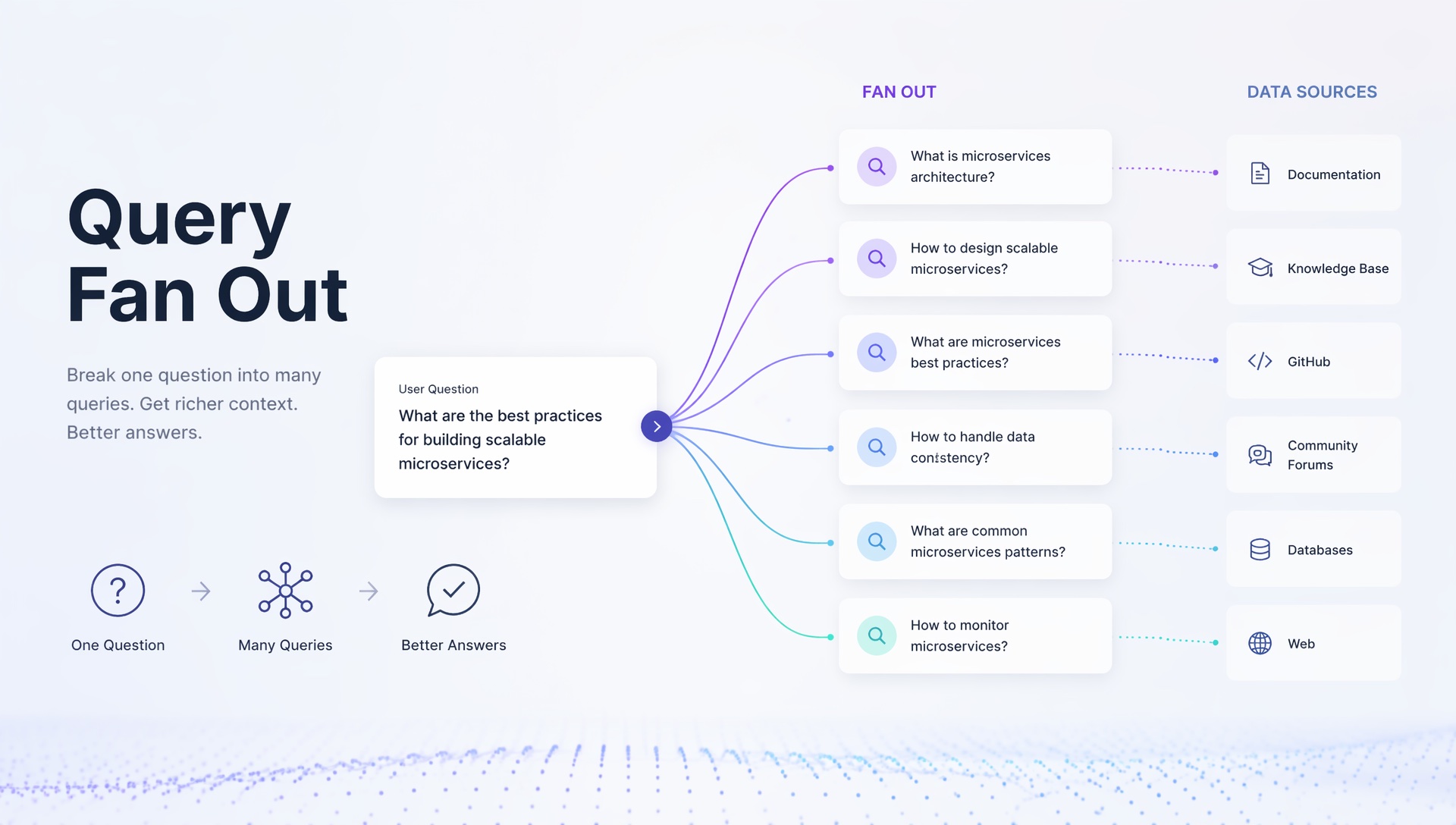
Query fan-out is when an AI search platform breaks one user prompt into multiple internal sub-queries, runs them in parallel, and merges the retrieved evidence into a single answer. The user sees one question; the model may run 5–11 searches (sometimes 20+) behind the scenes.
What it does: Fan-out decides which pages enter the AI’s context window and which brands get cited — often for keywords the buyer never typed.
How it helps marketers: Exposing recurring fan-out queries turns invisible retrieval into a content and keyword backlog — the sub-intents your brand must win to appear in merged answers.
Which models make it possible: Google AI Mode and AI Overviews (official query fan-out), ChatGPT with web search (Bing-backed parallel retrieval), Perplexity (native search index), Gemini with grounding, and Microsoft Copilot (RAG over Bing). Implementation and visibility differ by platform.
Quratic captures fan-out automatically during normal prompt collection — internal model queries plus related SERP searches — from local IPs in SG, JP, KR, MY, ID, and HK. See our query fan-out glossary entry for the full definition.
What is query fan-out? It is the hidden translation layer between conversational prompts and web retrieval. When a buyer asks ChatGPT, Perplexity, or Google AI Mode a compound question — “Best CRM for agencies in Singapore with Salesforce integration” — the platform rarely passes that sentence verbatim to a search engine. It decomposes the prompt into narrower internal searches, retrieves results for each, and synthesises one answer.
How does query fan-out help? It explains why you can rank on Google for one keyword and still disappear from AI answers. Your page may never match the sub-queries the model actually runs. Surfacing those sub-queries gives you a prioritised list of pages, comparisons, and locale-specific content to create — not guesses from classic keyword tools.
What does query fan-out do in practice? It expands one-to-one search into one-to-many retrieval. Google’s Search Central documentation states that AI Mode and AI Overviews use query fan-out to “issue multiple related searches across subtopics and data sources” so responses can surface a wider and more diverse set of helpful links than a classic web search. The fan-out strings — not the user’s original prompt — determine which domains get fetched and cited.
Which models and platforms make query fan-out possible? All major answer engines that combine generative search with live RAG retrieval use some form of decomposition:
| Platform | Fan-out mechanism | How fan-out is visible |
|---|---|---|
| Google AI Mode / AI Overviews | Parallel subtopic searches across web, Knowledge Graph, Shopping | Official docs; groundingMetadata.webSearchQueries in Gemini API |
| ChatGPT (web-enabled) | Multiple Bing API calls in parallel | OpenAI Responses API search metadata; UI citations |
| Perplexity | Parallel web + specialised retrieval streams | Browser SSE / citation panels |
| Gemini (grounded) | Google Search grounding | webSearchQueries in API metadata |
| Microsoft Copilot | Bing-backed RAG retrieval | Limited public fan-out exposure |
The rest of this article covers research evidence, platform differences, why geography changes fan-out in Asia, and how Quratic turns fan-out into actionable GEO work.
One prompt, many searches — how fan-out works
Classic SEO assumes a rough mapping: one keyword query → one SERP → one ranking opportunity.
AI search inverts that model. Ahrefs describes the shift as one-to-many: one conversational prompt expands into multiple related sub-queries so the model can gather comprehensive context before answering.
The pipeline has two layers that aiXiv research (Lee, 2026) documents across ChatGPT, Gemini, and Perplexity:
Layer 1 — Search trigger: Does the model answer from training data, or does it search the web at all? This decision is highly deterministic on some platforms (Gemini 98.9% trigger agreement in replicate testing) but varies sharply by ChatGPT model tier — gpt-5.4 searches on only 29% of queries while smaller models search on 100%.
Layer 2 — Query decomposition: When search triggers, the model generates fan-out strings — the actual retrieval queries. These strings vary session to session (45–73% completely different between runs on the same parent prompt, depending on platform), but a canonical core of roughly five strings covers 59–76% of fan-out events over repeated runs.
User prompt: "Best accounting software for SMEs in Malaysia"
                    │
        ┌───────────┼───────────┐
        ▼           ▼           ▼
   Fan-out A     Fan-out B     Fan-out C
   "accounting   "SME          "accounting
    software     accounting    software
    Malaysia"    MY 2026"      pricing MY"
        │           │           │
        └───────────┼───────────┘
                    ▼
         Merged AI answer + citations
Brands visible on only one sub-intent may be named with half the story — or omitted when a competitor covers pricing, reviews, and locale in separate fan-out slots. That is why prompt surfacing must include multi-intent variants, not only head terms.
What the data shows: scale, variance, and intent
Fan-out is not theoretical. Recent measurement studies quantify how often it fires and how it behaves.
Volume per prompt
Research summarised by Ahrefs from Seer Interactive and Nectiv found an average of 9–11 fan-out queries per prompt, with 59% triggering 5–11 searches and 24% triggering 12–19 — reaching as high as 28 on complex prompts.
The aiXiv cross-platform study classified 1,323 fan-out queries from 540 parent queries across ten commercial verticals and five intent types — the largest open taxonomy of fan-out behaviour published to date.
Intent shapes fan-out composition
User intent is a significant predictor of fan-out structure (χ² = 299.6, p < 0.001):
- Discovery queries trigger 3.3× the entity injection rate of informational queries — the AI pre-selects which brands to investigate before retrieval completes.
- Informational queries trigger compression — the model shortens the prompt into canonical keyword strings.
- Evidence-seeking fan-outs (reviews, comparisons, “is X legit”) rose to 15.6% in broader intent coverage — up from earlier narrow samples.
Practical implication: Optimise for fan-out types (comparison, pricing, review, locale, entity lookup), not exact string matching. Between any two runs, most literal fan-out strings differ — but the underlying retrieval types stay 55–65% stable across platforms.
Platform personalities differ
The same parent prompt produces different fan-out mixes by engine (aiXiv, 2026):
| Platform | Distinct fan-out behaviour |
|---|---|
| ChatGPT | 32% entity injection from training data — brands in the model’s weights get searched proactively |
| Gemini | 27% expansion queries — casts a wide retrieval net |
| Perplexity | 21% evidence-seeking — review- and comparison-oriented sub-queries |
Semrush’s analysis of 1B+ ChatGPT sessions (October 2024 – February 2026) adds upstream context: 65–85% of user prompts do not match any keyword in a 27-billion-keyword database. Average prompt length for search-enabled queries grew from 4.7 to 8.7 words. Buyers speak in natural language; fan-out translates that language into retrievable keywords the user never typed.
Google’s official framing
Google documents fan-out explicitly for site owners:
“Both AI Overviews and AI Mode may use a ‘query fan-out’ technique — issuing multiple related searches across subtopics and data sources — to develop a response.” — Google Search Central, AI Features and Your Website
Google’s AI Mode help documentation adds that AI Mode “divides your question into subtopics and searches for each one simultaneously” across web, Knowledge Graph, shopping data, and real-world information — then merges results into one response with links.
For SEO and GEO teams, the strategic shift is clear: visibility is not about ranking for one keyword. It is about covering the implicit sub-intents behind each conversational search — the same conclusion Ahrefs and Aleyda Solis draw from Google’s architecture.
Which models expose fan-out — and which hide it
Not every platform reveals internal queries equally. That matters for measurement tools and for Asian market teams choosing where to invest.
High fan-out exposure (API or browser metadata):
- ChatGPT — search metadata via OpenAI Responses API; multiple parallel Bing retrievals per answer
- Perplexity — citation panels and browser-level streams show retrieval paths
- Gemini (grounded) —
groundingMetadata.webSearchQueriesarray in the Gemini API
Lower direct exposure in collection payloads:
- Google AI Mode / AI Overviews — fan-out is documented and real, but internal query strings are not always exposed in third-party collection payloads the way ChatGPT and Perplexity are
- Copilot — RAG over Bing; limited public fan-out string visibility
In Quratic, this shows up in dashboard KPIs: known-query runs (internal searches extracted — mainly ChatGPT and Perplexity) vs SERP-related runs (related Google searches captured alongside the AI answer — a separate signal from internal model queries). Gemini and Google AI Mode captures often fall into the “unknown internal query” bucket even when fan-out clearly occurred upstream.
That is not a reason to ignore Google — it is a reason to combine fan-out data with Google rank tracking and citation intelligence on the same intents.
Why query fan-out matters more in Asian markets
Most fan-out explainers assume US English prompts collected from US infrastructure. Asian buyers break that assumption in three ways.
1. Locale sub-queries appear automatically
When a prompt is run from a local IP or language context, fan-out often adds locale signals the user never typed — country names, local language equivalents, regulatory context (“MAS-licensed,” “PDPA compliant,” “消費者庁”). Our glossary entry notes that content without explicit locale signals can lose fan-out slots to competitors with market-specific landing pages.
A Bahasa prompt in Indonesia or a Japanese prompt in Tokyo fans out into local-language searches that hit local sources — patterns a US-collected tool will never surface. We documented the collection gap with a fintech example: US API collection surfaced global neobanks; Singapore browser collection surfaced MAS-licensed local players.
2. CJK and multilingual entity disambiguation
Fan-out in Japanese, Korean, and Chinese markets adds entity disambiguation pressure. The model may fan out to romanised brand names, kana variants, or English comparison pages — each with a different retrieval set. Tracking fan-out in Tokyo, not California, reveals which variant the local model actually searches.
3. Platform mix differs by country
ChatGPT, Perplexity, and Gemini adoption varies by market. Fan-out behaviour you optimise for on ChatGPT may not apply to Google AI Mode — which matters enormously in markets where Google remains the primary discovery surface (Singapore search behaviour).
The unique requirement for Asian GEO: fan-out data must be collected from local IPs in each target country, not inferred from a global aggregate. Otherwise you optimise content for sub-queries buyers in your market never trigger.
How Quratic captures query fan-out
Quratic’s query fan-out capability extracts the internal queries and related SERP searches behind every AI response — automatically, with no extra setup.
What happens when you run prompts:
- Run prompts as usual — same scheduled collection across ChatGPT, Perplexity, Gemini, Google AI Mode, and other tracked models in your chosen markets
- Extract internal queries — Quratic parses each response for the model’s internal searches and any related SERP queries it surfaced
- Prioritise by frequency — top fan-out queries ranked by recurrence and whether your brand was cited in the same responses
Dashboard signals:
| KPI | What it tells you |
|---|---|
| Known-query runs | Captures where internal fan-out strings were extracted |
| Avg. fan-out | Average internal queries per known-query run |
| SERP-related runs | Related Google searches captured alongside the answer |
| Top queries | Recurring fan-out strings across prompts — with brand-cited flag |
| Prompt fan-out table | Which sub-queries each tracked prompt triggered |
Fan-out is the bridge between AI visibility (did we get mentioned?) and citation intelligence (which domains fed the answer?). It answers the question prompt tracking alone cannot: what did the model search for before it decided?
For the formal definition, related concepts, and technical context, see Query fan-out in the Quratic glossary — linked to RAG, generative search, and answer engines.
What to do with fan-out data — a practical workflow
Fan-out turns GEO from “track mentions” into “fix retrieval gaps.”
Step 1 — Find recurring sub-queries you do not rank for
Open the Top queries view. Sort by frequency across your category prompts. Sub-queries appearing on 30%+ of runs are high-leverage content targets — comparison pages, pricing tables, integration guides, locale landing pages.
Step 2 — Map fan-out gaps to content types
Use the aiXiv type taxonomy as a checklist:
- Compression → concise definitional pages and FAQ schema
- Entity lookup → strong brand entity pages and third-party validation
- Evidence-seeking → reviews, case studies, independent comparisons
- Expansion → broad category hubs that cover adjacent sub-intents
- Locale injection → market-specific pages with explicit country/regulatory signals
Step 3 — Cross-check Google rank on the same sub-intent
If a fan-out query recurs but your Google rank for that string is page 3+, you have a dual gap — fix SEO first, then refresh content for AI citation structure. Our split-screen SERP framework pairs both lenses in one report.
Step 4 — Expand your prompt library from fan-out discoveries
Fan-out surfaces topics you would never have added manually — the blind spots competitors win quietly. Feed new sub-queries back into your AEO/GEO playbook prompt library.
Step 5 — Prioritise by citation, not mention alone
A fan-out query where competitors’ domains are cited but yours is not is higher priority than a query where you are mentioned but not linked. Citation rate on Perplexity and Google AI Mode often drives purchase consideration more than name-drops alone.
Query fan-out vs prompt tracking vs keyword research
| Method | What it measures | Limitation |
|---|---|---|
| Keyword research (SEO tools) | Historical search volume for typed queries | Misses conversational prompts; no AI decomposition |
| Prompt tracking (GEO tools) | Your chosen questions → final AI answer | Blind to internal searches between prompt and answer |
| Query fan-out (Quratic) | Internal sub-queries + related SERP searches | Exposure varies by platform payload |
| Profound Conversation Explorer | Real-user prompt demand at scale | Global aggregate; not derived from your tracked prompt runs in local markets |
Fan-out complements prompt tracking — it does not replace it. Prompt tracking tells you whether you won the answer. Fan-out tells you which hidden searches decided the winner.
FAQ
What is query fan-out in simple terms?
Query fan-out is when an AI platform silently runs multiple internal searches while answering one user prompt, then merges the results. It is defined in our glossary and documented officially by Google Search Central.
How many fan-out queries does a typical prompt trigger?
Industry research cites 9–11 fan-out queries on average (Ahrefs / Seer / Nectiv), with 59% of prompts triggering 5–11 searches and complex prompts reaching 20+. Exact counts vary by platform, intent, and model tier.
Does ChatGPT always search the web when answering?
No. Research on ChatGPT model tiers shows flagship models search on as few as 29% of queries, while smaller models search on 100%. Informational queries trigger search only 12% of the time on some configurations. Your content may be invisible not because the model cannot find you — but because it never searched.
Which AI platforms use query fan-out?
Google AI Mode, AI Overviews, ChatGPT (web-enabled), Perplexity, Gemini (grounded), and Microsoft Copilot all use parallel sub-query retrieval. Architecture differs: Google uses its own index plus Knowledge Graph and Shopping; ChatGPT and Copilot use Bing; Perplexity uses its own search stack.
How is Quratic query fan-out different from tracking prompts?
Prompt tracking monitors the questions you choose. Query fan-out reveals the additional searches the AI runs behind the scenes on those same prompts — collected from local IPs in Asian markets so sub-queries reflect your category and country, not a US default.
Why does fan-out matter more for brands in Singapore, Japan, and Southeast Asia?
Fan-out queries are language- and market-specific. Local IP collection surfaces sub-queries in Bahasa, Japanese, Korean, and English-local variants that US infrastructure misses. Without local browser collection, you optimise for fan-out patterns your buyers never trigger.
Should I optimise for exact fan-out strings or fan-out types?
Optimise for types (comparison, pricing, review, locale, entity) — not verbatim strings. Cross-platform research shows 45–73% of literal fan-out strings differ between runs, but fan-out types stay 55–65% stable. Build content coverage for the type, not one captured string.
Do I need extra setup to capture fan-out in Quratic?
No. Fan-out is captured automatically whenever your prompts run across collection cycles. See the query fan-out capability page for dashboard details.
Bottom line: Query fan-out is the mechanism that decides which sources enter AI answers. Tracking only the final response leaves you blind to the searches that actually picked the winner. For Asian markets, collecting fan-out from local IPs is the difference between optimising for your buyers’ retrieval paths — and optimising for a US aggregate that never applied.
See query fan-out in Quratic — internal sub-queries, top recurring searches, and citation coverage from local collection in six Asian markets. Read the full definition in our glossary.