API vs browser collection: why how you measure AI visibility changes the answer
· Updated June 19, 2026 · 4 min read

Former Product Lead, JPMorgan Asset Management, AIA & AXA
Vendor APIs and real browser sessions produce different AI visibility data. Here is why collection method matters for marketers in Asia.
On this page
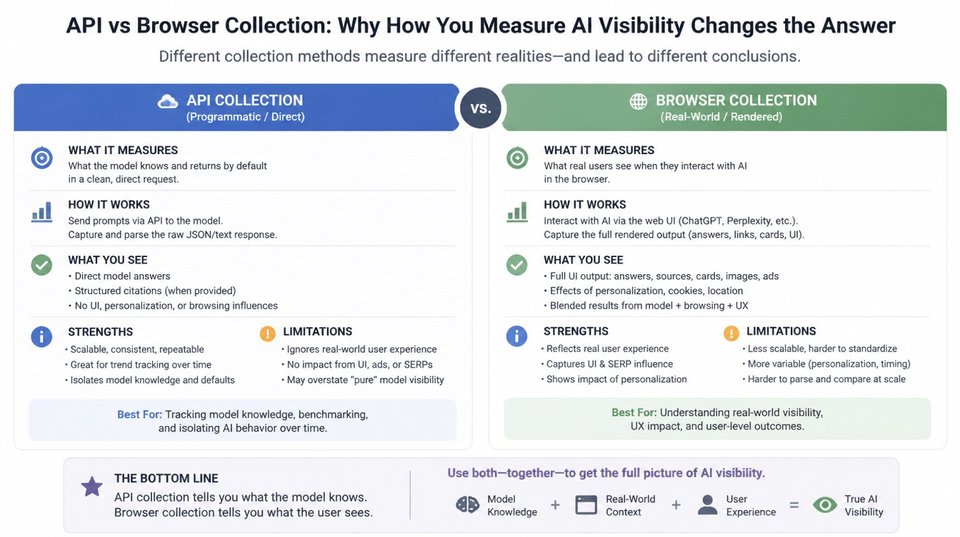
The way you collect AI visibility data determines what you measure. Tools that call model APIs from US datacenters return generic answers. Tools that open real browsers on local residential IPs return what buyers in Singapore, Tokyo, or Seoul actually see. For Asian markets, that difference is not academic — it changes your visibility score.
Why do collection methods produce different results?
AI search products like Perplexity and Google AI Mode retrieve live web content. Their answers depend on:
- The user’s IP location
- The platform interface (logged-in vs public, AI Mode vs standard)
- Real-time web indexes that vary by region
A vendor API strips away most of that context. You get a response — but not the response your buyer gets.
API-based collection: what you get
Typical API-based AI visibility tools:
- Send your prompt to a model endpoint from a datacenter
- Return a clean, repeatable text response
- Miss live web retrieval nuances on Perplexity and Google AI
- Ignore country-level IP effects entirely
Best for: quick directional signal, US/EU teams where local IP variance is less critical.
Weak for: markets where AI pulls local web results — which includes most of Southeast and East Asia.
Browser-based collection: what you get
Browser-based collection:
- Opens the actual AI product interface (ChatGPT, Perplexity, Google AI Mode, etc.)
- Routes traffic through a residential IP in the target country
- Captures the full answer, including cited sources
- Stores responses for visibility, position, sentiment, and citation analysis
Best for: brands and agencies that report AI visibility to leadership or clients in specific countries.
Side-by-side comparison
| Factor | API collection | Browser + local IP |
|---|---|---|
| Location fidelity | Datacenter (often US) | Residential IP per country |
| Perplexity accuracy | Lower — misses live web layer | Higher — matches local user |
| Google AI Mode | Often unavailable or generic | Full interface collection |
| Citations captured | Limited | Full source list |
| Repeatability | Very high | High (scheduled runs) |
| Buyer representativeness | Low in Asia | High in Asia |
A real-world example
Imagine a fintech brand tracking the prompt “best digital banks in Singapore”.
- API collection might return global neobanks with strong US press coverage.
- Browser collection from a Singapore residential IP might surface local players, MAS-licensed institutions, and region-specific review sites — a different competitive set entirely.
If your GEO programme optimizes for the API answer, your team may invest in the wrong content and PR targets.
What about Gemini and Copilot?
Some AI surfaces require authenticated browser sessions. Gemini and Microsoft Copilot often behave differently for logged-in users. Collection methods must match the user experience you are trying to measure — another reason API-only approaches fall short.
How should marketers choose?
Ask three questions:
- Do my buyers use AI search in specific countries? If yes, local IP collection is essential.
- Do I report visibility to clients or executives? If yes, data fidelity matters more than cheap volume.
- Does my category rely on live web citations? Finance, SaaS, travel, and consumer goods in Asia typically do.
If you answered yes to any of these, browser-based collection is the baseline — not a premium upgrade.
FAQ
Is browser collection slower or more expensive?
It requires more infrastructure — proxies, schedulers, and storage per response. That is why accurate Asian market data has historically been hard to access. Platforms like Quratic absorb that complexity for marketing teams.
Can I use API data for trending only?
Yes, if you treat it as directional. Do not compare API-based numbers month-over-month against browser-based numbers, or US numbers against Singapore numbers.
Does Google Analytics show AI visibility?
No. GA tracks site traffic, not whether ChatGPT mentioned your brand. You need a dedicated AI visibility platform.