Platform capabilities / Sentiment tracking
Sentiment tracking
Quick answer
Track how AI describes your brand — positive recommendations, neutral mentions, or negative framing.
The problem
Being mentioned is not the same as being recommended. An AI answer can name your brand and then undercut it — "X is popular but expensive," "Y had reliability issues," or a flat mention buried beneath competitors it actively praises. Worse, models repeat outdated or inaccurate claims with total confidence. If you only count mentions, you miss the half of the story that decides whether a buyer chooses you.
How Quratic helps
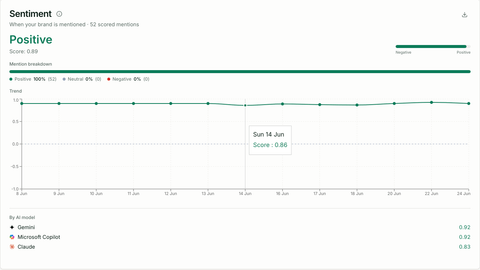
Quratic scores the sentiment of every brand mention in context — positive, neutral, or negative — across your tracked prompts and models. See how framing trends over time, compare it against competitors, and drill into the exact answers where AI describes your brand unfavourably, so you can correct the record and fix the sources feeding it.
What you get
-
Know how AI frames you
A sentiment score for every mention so you can tell the difference between a recommendation and a backhanded compliment.
-
Catch negative answers early
Surface the prompts where AI describes your brand unfavourably — and read the exact wording so you can respond.
-
Benchmark against rivals
See whether AI speaks more warmly about competitors and where you need to shift the narrative.
How it works
- 1
Capture the full answer
Every run stores the complete response text, so sentiment is scored on real context, not a snippet.
- 2
Score sentiment in context
Quratic evaluates how your brand was described in that specific answer and assigns a positive, neutral, or negative label.
- 3
Trend and alert
Track sentiment over time by prompt, model, and market, and review the answers behind any decline.
Why it matters in Asia-Pacific
Tone travels badly across languages and markets. A model may recommend your brand warmly in English for Singapore yet hedge in Japanese for Tokyo, citing different local sources and concerns. Because Quratic collects each prompt on a local IP in its own language, sentiment reflects how buyers in that specific market actually hear about you — not an English-only average.
Related terms
Related capabilities
Frequently asked questions
- How does Quratic score AI sentiment?
- After each collection run, Quratic analyses how the AI described your brand in context — positive recommendation, neutral mention, or negative framing — and aggregates scores by prompt, model, and market.
- Can sentiment change between markets?
- Yes. AI answers vary by country and language. A brand described positively in Singapore may be framed differently in Japan or Korea. Local IP collection captures these market-specific differences.
- Can I read the answers behind a sentiment score?
- Yes. Quratic stores the full response text for every run, so you can read exactly what the AI said about your brand and decide how to respond.
- Why does my brand get negative sentiment when it is mentioned?
- Models often repeat caveats or outdated claims from the sources they cite. Sentiment tracking pairs with citation intelligence so you can trace negative framing back to the content feeding it.
Ready to close the loop on AI search?
Other tools tell you you’re losing AI search. Quratic helps you win it — track, diagnose, brief, and draft content your team reviews and approves before it publishes.
30-day free trial · No credit card · You approve every draft