The split-screen SERP report: how to read Google rank and AI visibility together
PublishedJune 13, 2026 · UpdatedJune 19, 2026 · Quratic Team · 8 min read
Organic rank, AI Overview ownership, and AI answer mentions tell different stories. Here is a framework for reading all three — and deciding what to fix first.
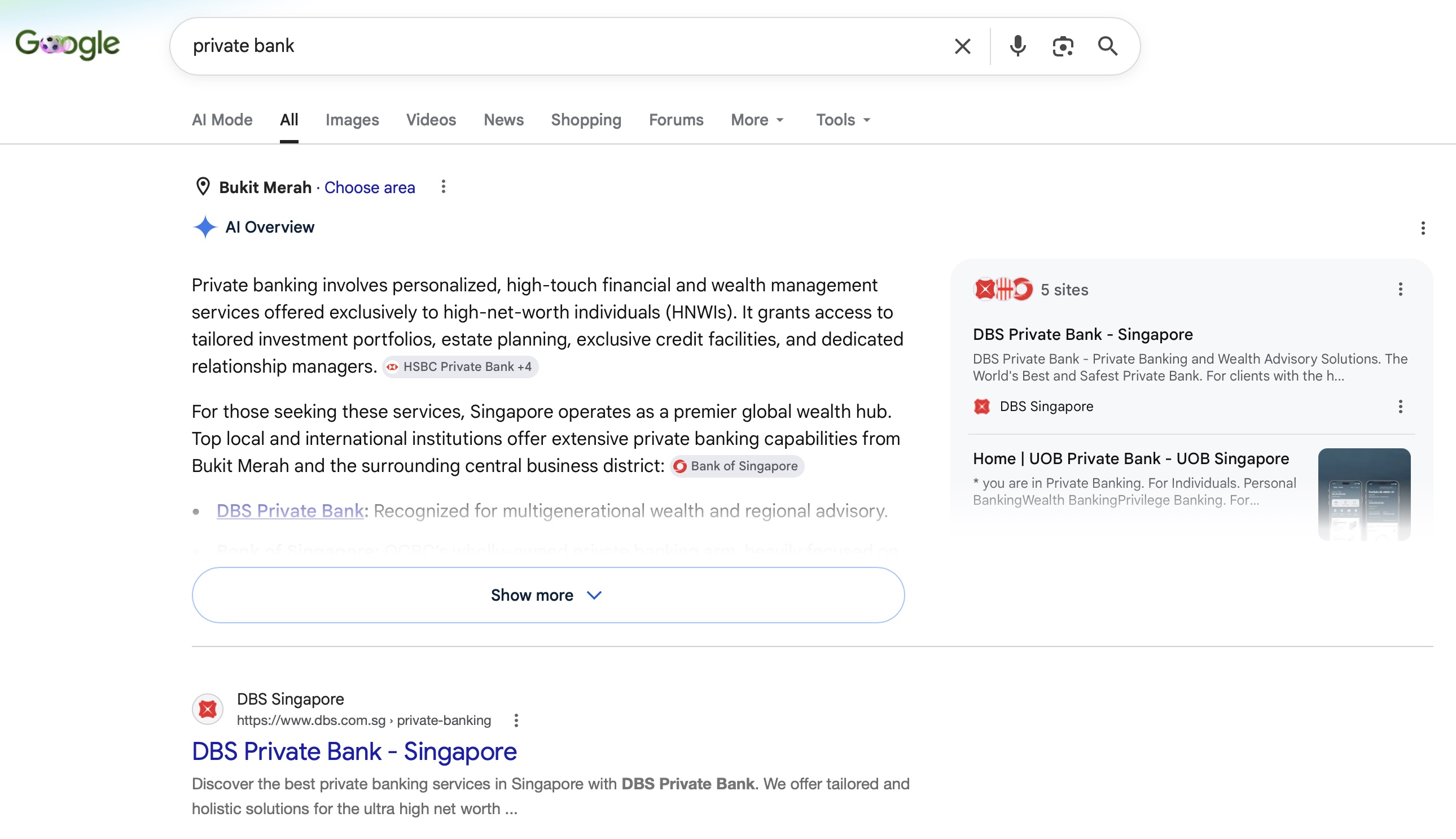
Most marketing dashboards still show one number per keyword: rank. That made sense when search meant ten blue links. In 2026, the same keyword produces a Google SERP with an AI Overview, paid slots, and forum blocks — and a separate answer in ChatGPT or Perplexity that may name entirely different brands.
The fix is not a bigger spreadsheet. It is a split-screen report: classic Google rank on one side, AI visibility on the other — read together, by country and device.
This guide is the framework Quratic teams use to turn Rankings + AI Visibility data into weekly decisions. No theory without a decision attached.
The four numbers that replace “rank”
For each priority keyword (or matching prompt intent), track:
| # | Metric | What it answers | Where it lives |
|---|---|---|---|
| 1 | Organic rank (mobile + desktop) | Do we appear on page one in Google? | Search / Rankings |
| 2 | AI Overview ownership | Does Google cite us in the SERP summary? | Search / Rankings (SERP features) |
| 3 | AI mention rate | Do ChatGPT, Perplexity, Gemini name us? | AI Visibility / prompts |
| 4 | Competitor share | Who wins each layer vs us? | Both |
A keyword where you score well on #1 but poorly on #2–#4 is a false positive — the classic “we rank #3 but lose the SERP” pattern we described separately.
A keyword where you score poorly on #1 but well on #3 is a hidden win — AI is recommending you before organic catches up, often via third-party citations.
Both patterns require action. Neither shows up if you only watch rank.
The 2×2 matrix: where you sit and what to do
Plot each priority keyword (or cluster) on two axes:
- X-axis: Organic rank (page one = right, not page one = left)
- Y-axis: AI visibility (mentioned in ≥50% of prompt runs = top, below = bottom)
You get four quadrants:
                    High AI visibility
                           │
         Q2: FIX SEO       │   Q1: DEFEND
    "AI likes us,         │   "Winning both
     Google doesn't"      │    layers"
                           │
  Not page one ────────────┼──────────── Page one
                           │
         Q4: URGENT       │   Q3: FIX GEO
    "Invisible            │   "Google OK,
     everywhere"          │    AI ignores us"
                           │
                    Low AI visibility
Q1 — Defend (page one + strong AI visibility)
Signal: You own the keyword across layers. Competitors are attacking.
Actions:
- Monitor weekly — rank movers and SOV drift
- Refresh content quarterly to hold AI Overview citations (freshness matters for Perplexity and increasingly for Google)
- Track forum/discussion blocks for narrative risk
Report to leadership: “Category leader on [keyword] — maintaining.”
Q2 — Fix SEO (weak organic, strong AI)
Signal: AI engines cite you (often via review sites or PR), but Google organic lags.
Actions:
- Identify which URLs AI cites — optimise those pages for traditional ranking signals
- Close technical gaps (mobile CWV, indexation, internal linking)
- Do not assume AI visibility will sustain without organic foundation — Google AI Overviews lean on Search signals
Report to leadership: “AI shortlist strong; SEO catch-up needed on [keyword].”
Q3 — Fix GEO (page one, weak AI)
Signal: The most common gap for established brands. You rank well; AI answers omit you or favour competitors.
Actions:
- Map AI citations for the intent — which domains appear instead of you?
- Lead key pages with extractable direct answers
- Build third-party citation footprint (comparison sites, local publishers in Asia)
- Run prompts from local residential IPs — US checks lie
Report to leadership: “Rank #2 on Google; absent from ChatGPT answers — GEO sprint on [keyword].”
Q4 — Urgent (weak on both)
Signal: Pipeline risk. Category queries surface competitors everywhere.
Actions:
- Triage: is the keyword wrong, the market wrong, or the content wrong?
- Check mobile rank separately — you may be page one on desktop only (mobile/desktop gaps of 5+ positions are common)
- Parallel SEO + GEO workstreams; do not serialise
Report to leadership: “Critical gap on [keyword] — combined SEO/GEO plan.”
Building the split-screen report: step by step
Step 1 — Align keywords and prompts
Pair each tracked keyword with one or more prompts that express the same buyer intent:
| Keyword (Search) | Matching prompt (AI Visibility) |
|---|---|
best crm for sme singapore | ”What is the best CRM for SMEs in Singapore?” |
quratic vs profound | ”Compare Quratic and Profound for AI visibility” |
ai visibility tool asia | ”Which AI visibility platform is best for Asian markets?” |
Intent alignment matters. Ranking for a navigational keyword while tracking a category-discovery prompt produces nonsense in the matrix.
Step 2 — Segment by country and device
Country: A keyword in SG and a prompt assigned to Singapore must match. Country-level variance is large in Asia.
Device: Track mobile and desktop rank separately. Default to mobile for consumer and mobile-first markets; desktop for B2B if your analytics confirm office-hour desktop traffic.
Quratic treats device as part of the keyword unit — choosing “both” creates two rows. That mirrors how Google actually serves results.
Step 3 — Pull the four numbers weekly
From Rankings (Search lens):
- Brand organic position (latest capture)
- AI Overview position / cited flag
- Competitor organic positions on same SERP
- Paid and forum feature flags
From AI Visibility:
- Mention rate (% of runs naming your brand)
- Position (first, second, third named)
- Citation domains in answers
- Share of voice vs tracked competitors
Step 4 — Colour the matrix
Simple traffic-light for leadership decks:
| Quadrant | Colour | One-line status |
|---|---|---|
| Q1 Defend | Green | Winning both |
| Q2 Fix SEO | Amber | AI ahead, SEO behind |
| Q3 Fix GEO | Amber | SEO ahead, AI behind |
| Q4 Urgent | Red | Gap on both |
Limit to 10–15 keywords in the executive view. Analysts drill into the full list.
Step 5 — Assign one owner per quadrant action
Split-screen reports fail when they become read-only. Each red/amber cell needs:
- One named owner
- One concrete action (refresh page, pitch review site, fix mobile CWV)
- Review date (4-week default for GEO; 8-week for SEO)
What to show leadership vs what analysts need
Weekly leadership slide (5 minutes)
- Matrix snapshot: count of keywords per quadrant
- Top 3 rank movers (biggest gain/loss in organic position)
- Top 3 AI SOV changes (mention rate shift vs competitors)
- One “SERP loss” example: good rank, competitor owns AI Overview (with screenshot if available)
Analyst dashboard (daily/weekly)
- Full keyword table: mobile rank, desktop rank, AIO cited Y/N, mention rate by model
- Citation domain list per prompt cluster
- Competitor overlap: who appears in Google organic and AI answers
- Recent SERP captures cross-checked against bot crawl logs
Reading conflicts between the two screens
Some patterns come up repeatedly:
“Rank improved, AI mentions dropped.” Often a content refresh helped SEO but removed extractable passages AI relied on. Compare page structure before/after.
“AI mentions up, rank flat.” Third-party citations driving AI — your domain is not the source. PR/review site strategy working; on-site SEO not yet converted.
“AIO cited us, ChatGPT ignores us.” Different retrieval architectures. Google AI Overviews use Search signals; ChatGPT uses its own browse index. Fix both paths.
“Strong in SG, weak in JP.” Expected. Do not average APAC. Separate matrix per market.
“Desktop page one, mobile page three.” Common in Asia. Report mobile to leadership for consumer categories; mobile-first indexing makes mobile the primary ceiling.
A lean-team version (under budget pressure)
If marketing budget is tight, start minimal:
- 5 keywords in your primary revenue market
- 5 matching prompts on ChatGPT + Perplexity
- Mobile rank only (unless B2B desktop-heavy)
- One competitor tracked on both sides
- Monthly matrix review — upgrade to weekly when SOV becomes a reported KPI
Cost of manual split-screen: 5 keywords × 2 devices × 3 AI models × 4 weeks = 120+ checks/month by hand. Automated collection is the difference between a framework you use and one you abandon.
FAQ
Do keywords and prompts need identical wording?
No — intent alignment matters more than exact text. “Best CRM Singapore” and “What CRM should a Singapore SME use?” are a valid pair. “Quratic pricing” and “best CRM Singapore” are not.
Which AI models belong on the split-screen?
Minimum: ChatGPT + Perplexity + Google AI Mode or Overviews. Add Gemini if Android/Workspace buyers matter in your market. Platform guide here.
How often should the matrix update?
Weekly for competitive categories; bi-weekly for stable B2B. AI answers drift faster than organic rank — scheduled collection beats quarterly manual audits.
Can we use this if we only have Rankings, not AI prompts yet?
Yes — organic + AIO alone is already better than rank alone. Add prompts when ready to populate the Y-axis. Half a split-screen beats a single number.
Where does Siri AI fit?
Siri AI is emerging as a third column eventually. For now, Google SERP + major AI chatbots cover the majority of discovery paths in Asia.
Build your split-screen report in Quratic — Rankings and AI Visibility in one project, six Asian markets, free trial to baseline both sides.