Platform capabilities / Google rank tracking
Google rank tracking
Quick answer
Monitor localized Google organic positions, page-one coverage, and SERP features alongside your AI visibility.
The problem
AI answers did not replace Google — they sit on top of it. A brand can rank #1 organically yet never appear in an AI Overview, or get cited by ChatGPT while sliding off page one. Running an AI visibility tool and a separate SEO rank tracker leaves you stitching two stories together by hand, with no shared view of where discovery is actually happening.
How Quratic helps
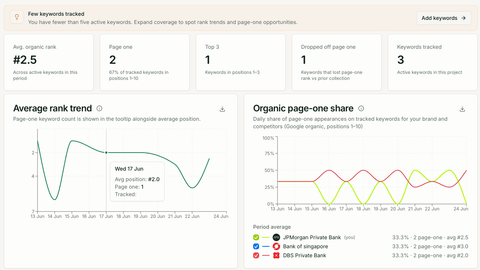
Quratic tracks localized Google organic rankings in the same project as your AI visibility. Monitor position, page-one coverage, SERP-feature ownership, and rank changes by market and device — collected through the same residential-IP browser sessions as your AI prompts. AI answers and classic search, side by side, in one dashboard.
What you get
-
One view of discovery
AI visibility and Google rankings in the same project, so you can see the full picture instead of two disconnected reports.
-
Localized, device-aware ranks
Track organic position, page-one rate, and SERP features by market and by desktop or mobile — the way local buyers really search.
-
Connect the two channels
Spot where you rank but are not cited by AI — and where AI names you despite weak organic position — to target the right fix.
How it works
- 1
Add target keywords
Assign each keyword to a market and device, alongside the AI prompts in the same project.
- 2
Collect on local IPs
The same residential-IP browser sessions that run your prompts also capture localized SERPs, so results match what users see.
- 3
Track position and features
Monitor rank changes, page-one coverage, and SERP-feature ownership over time, next to your AI metrics.
Why it matters in Asia-Pacific
Localized Google results are essential in Asia-Pacific, where domains, languages, and SERP features shift by country — google.co.jp, google.com.sg, google.co.id all return different results. Collecting from a residential IP in each market means your rank data reflects the real local SERP, and lives beside your AI visibility so you can manage both channels for the same market in one place.
Related terms
Related capabilities
Frequently asked questions
- Does Quratic replace an SEO rank tracker?
- Quratic covers localized Google organic rankings alongside AI visibility in one dashboard. For deep SEO workflows (backlinks, site audits, keyword research at scale), pair Quratic with a dedicated SEO tool.
- Are Google rankings collected from local IPs too?
- Yes. Keyword rank collections use the same residential-IP browser sessions as AI prompt collection, so SERP results reflect what users in that market see.
- Can I track desktop and mobile separately?
- Yes. Keywords are tracked by market and device, so you can compare desktop and mobile rankings — important in mobile-first APAC markets like Indonesia.
- Why track Google rankings next to AI visibility?
- Because buyers use both. Seeing them together reveals gaps — strong organic rank with no AI citation, or AI mentions without page-one presence — that a single-channel tool would miss.
Ready to close the loop on AI search?
Other tools tell you you’re losing AI search. Quratic helps you win it — track, diagnose, brief, and draft content your team reviews and approves before it publishes.
30-day free trial · No credit card · You approve every draft