ChatGPT ads vs shopping cards: what marketers should track in AI answers
· 7 min read

Former Product Lead, JPMorgan Asset Management, AIA & AXA
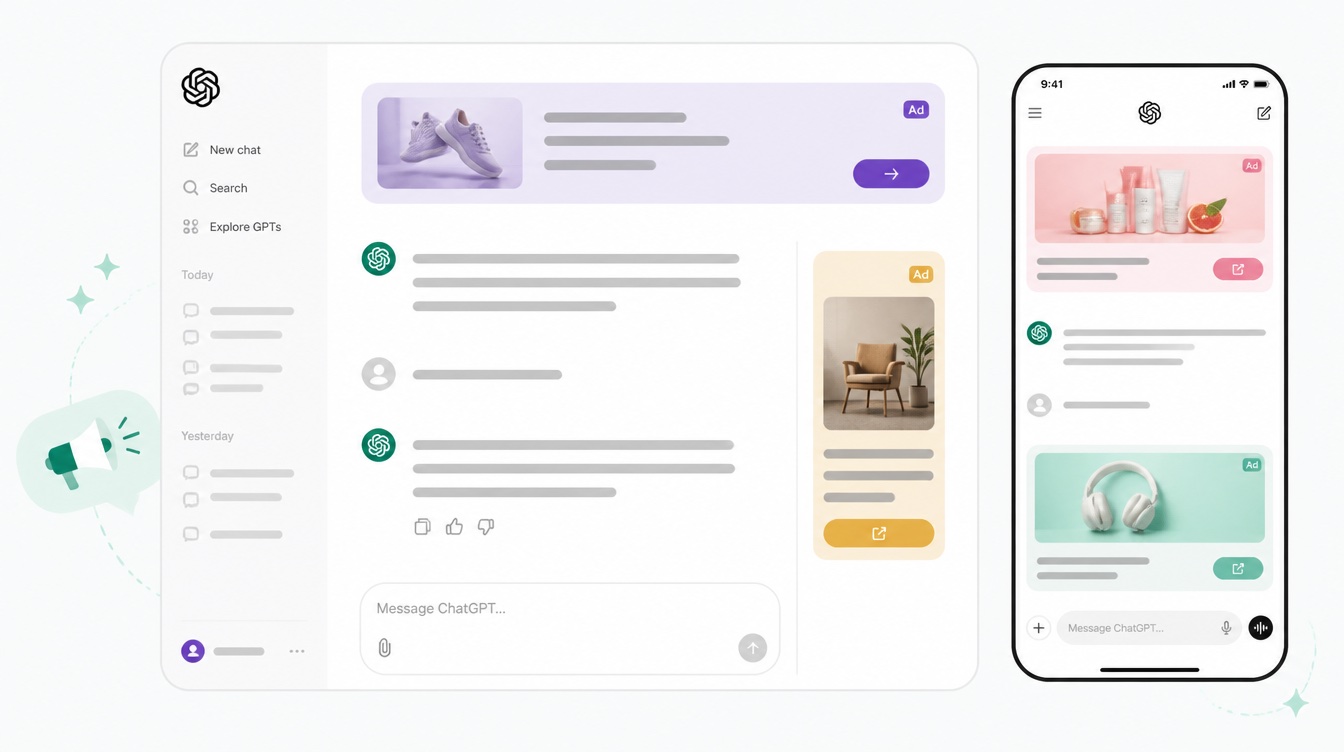
ChatGPT is showing sponsored ads inside answers — separate from shopping cards. Here is what they are, how they differ from Google paid ads, and how to measure them with market-local collection.
On this page
For years, GEO programmes tracked whether ChatGPT mentioned your brand and whether it cited your site. Then shopping cards arrived — structured product carousels with prices and sellers. Now a third layer is showing up on commercial prompts: sponsored ads inside the ChatGPT answer.
If your dashboard only counts prose mentions, you are missing inventory your competitors may already be buying or earning — in the markets where OpenAI has turned ads on.
Where ChatGPT ads are available now
OpenAI is still in a limited geographic pilot. Ads are not global.
As of mid-2026, ChatGPT ads (and Ads Manager access) are reported live in roughly these markets:
| Region | Markets with ChatGPT ads today |
|---|---|
| Americas | United States, Canada |
| Europe | United Kingdom |
| Oceania | Australia, New Zealand |
| Asia | Japan, South Korea |
Not in the pilot yet (examples): Singapore, Malaysia, Indonesia, Thailand, Taiwan, Hong Kong, and most of continental Europe. OpenAI has discussed further expansion (e.g. Brazil, Mexico were named in earlier updates), but availability still changes market by market — treat the list above as the practical baseline and re-check OpenAI’s Ads Manager availability when you plan spend.
Two more constraints matter for measurement:
- Subscription tier — ads are tested for logged-in adult users on Free and Go; Plus, Pro, Business, Enterprise, and Education remain ad-free.
- Commercial intent — even in a live market, ads appear only on eligible prompts; many informational queries will return zero
ads.
What that means for Quratic APAC collection
| Quratic market | ChatGPT collection | Expect ChatGPT ads? |
|---|---|---|
| Japan | Yes | Yes — in the current pilot |
| South Korea | Yes | Yes — in the current pilot |
| Australia | Yes | Yes — in the current pilot |
| Singapore, Malaysia, Indonesia, Thailand, Taiwan | Yes | Unlikely for now — shopping cards can still appear; ads usually will not |
| Hong Kong | ChatGPT blocked | N/A |
So for SEA brands: keep tracking shopping cards and brand mentions everywhere you collect; treat Ads as an early signal in JP / KR / AU (plus US/UK/CA/NZ if you expand collection there), not as a pan-ASEAN KPI yet.
What is a ChatGPT ad?
A ChatGPT ad is a sponsored unit returned with the answer — typically:
| Field | What it means |
|---|---|
| Title | Ad headline |
| URL | Destination / click-through |
| Advertiser | Who is paying / branding the placement |
| Rank | Order among sponsored units in that answer |
These appear conditionally — mostly on commercial-intent prompts in pilot countries (“best sleep supplements,” “best CRM tools”), not on every informational query and not in every market.
They are not:
- A brand name-drop in the paragraph
- An LLM citation in the sources panel
- A shopping card / AI product mention with price and seller
- A Google paid search ad above the organic SERP
Ads vs shopping cards vs Google paid
| Surface | Where it lives | What you get | Quratic home |
|---|---|---|---|
| ChatGPT shopping cards | Inside ChatGPT answer | Product title, price, optional URL | Products tab |
| ChatGPT ads | Inside ChatGPT answer (pilot markets) | Sponsored title, advertiser, URL | Ads tab (ChatGPT only) |
| Google AI Overviews products | Inside AI Overview / SERP AI block | Popular-products carousel | Products tab |
| Google paid ads | Classic SERP sponsored slots | Title, URL, description, position | Searches / SERP views |
Mixing Google paid into an “AI ads” report confuses two buying journeys. A buyer asking ChatGPT “best running shoes Singapore” may never open Google that day. A buyer searching Google may never open ChatGPT. Measure both — but keep the ledgers separate.
Why this matters for Asia brands
ChatGPT answers vary by geo. Collection that routes through local residential IPs is closer to what buyers see than a US API dump — and that matters even more while ads are only live in a handful of countries.
Practical implications:
- Do not expect ads in SG / MY / ID yet — empty Ads tabs there are usually rollout reality, not a collection bug.
- JP, KR, and AU are the APAC markets to watch first — advertisers and agencies in those countries can already show up next to category answers.
- Shopping cards and ads can diverge — you can win the carousel and still lose the sponsored slot (or the reverse) in markets where both exist.
- Marketplace-heavy markets (MY, ID) still need product-mention tracking; ads will matter more as OpenAI expands the pilot.
If your GEO report only says “mentioned / not mentioned,” leadership will not see whether you lost the ad slot next to a competitor — in the markets where that slot exists.
What marketers should do this quarter
- Prioritise ads KPIs in live markets — JP, KR, AU (and US/UK/CA/NZ if relevant); keep shopping-card KPIs everywhere else.
- Add commercial prompts that would trigger shopping or ads UI — “best X,” “top Y under $Z,” “[category] for [use case].”
- Separate KPIs — mention rate, citation rate, product-card presence, and (where live) ChatGPT ad presence / advertiser share.
- Do not conflate with Google Ads — keep Search paid reporting where it belongs; use AI Products & Ads for in-answer commerce surfaces.
- Optional catalog — still helps own-brand detection on shopping cards; ChatGPT ads are advertiser placements, so treat them as competitive ad inventory, not SKU matching.
How Quratic tracks this
Quratic collects ChatGPT via Oxylabs with structured parse enabled. When ChatGPT returns:
shopping_products→ stored as product mentions (kind: product)ads→ stored as ChatGPT ads (kind: ad)
The Products & Ads page splits them into tabs. If a market is outside OpenAI’s ads pilot, the Ads tab will usually stay empty — while Products can still fill from shopping cards. Google paid ads remain on keyword/SERP views so AI commerce and classic Search stay easy to explain to a CMO.
Related reading: What are AI product mentions? · API vs browser collection · Glossary: AI product mentions
Track ChatGPT shopping cards and ads in Quratic — market-local collection across Asia-Pacific, with Products & Ads reporting kept separate from Google paid search.