What are AI product mentions? How to track shopping cards from ChatGPT and Google AI Overviews in Asia
· 7 min read

Former Product Lead, JPMorgan Asset Management, AIA & AXA
AI product mentions are the product cards inside ChatGPT and Google AI Overviews — titles, prices, sellers, and links. Here is how to track them in Asian markets, with or without a product catalog.
On this page
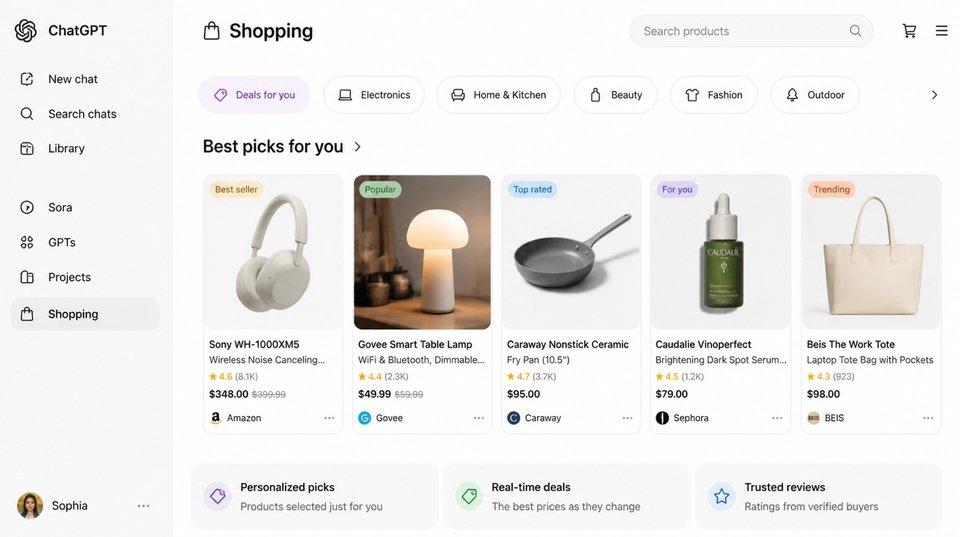
Buyers increasingly ask AI what to buy before they open a marketplace app. The answer is not only paragraphs — it is often a product carousel: four running shoes with prices, a headphone lineup with sellers, a Google Shopping module with “Popular products.”
That carousel is invisible to classic SEO dashboards. Keyword rankings and share of voice in prose do not tell you whether your SKU appeared in the shopping module, at what price, or whether Shopee beat your brand site as the destination.
AI product mentions are Quratic’s name for those extracted cards — and they are becoming a core e-commerce GEO metric in Southeast Asia.
What counts as an AI product mention?
An AI product mention is one structured product row parsed from a shopping-style AI response:
| Field | Example |
|---|---|
| Title | “Sony WH-1000XM5 Wireless Noise Cancelling Headphones” |
| Price | “$379.00” or “SGD 379” |
| Seller | “store.sony.com.sg”, “iRUN Singapore”, or blank |
| URL | Brand URL, marketplace link, or Google Shopping redirect |
| Rank | Position in the carousel (1st, 2nd, …) |
These differ from:
- Brand mentions in text — “Sony is a leading option…” without a card
- LLM citations — source links in the footnote panel
- Organic SERP rankings — blue links below the AI block
You can rank organically, get cited in sources, and still lose the shopping carousel — or win the carousel without being named in the summary.
Which AI platforms show product cards?
In Quratic’s current collection pipeline (Phase 0), structured extraction targets:
| Platform | Typical shopping UI | Notes for Asia |
|---|---|---|
| ChatGPT | shopping_products cards | Often title + price only; URLs may be missing |
| Google AI Overviews | popular_products carousel | Strong seller + price signal; often Google Shopping URLs |
| Perplexity / Gemini | Prose + citations | Structured shopping modules not reliably present yet |
Collection uses local residential IPs in SG, JP, KR, MY, ID, and HK — the same constraint as the rest of Quratic’s GEO measurement. A US API snapshot of ChatGPT will not show the Shopee-heavy carousel a buyer in Jakarta sees.
Do you need a product catalog?
No. The Products dashboard shows every extracted card for your tracked prompts — competitor products, marketplace listings, and yours.
Uploading a catalog is the optional second layer:
- Import SKUs via CSV or add rows in Settings → Products
- On each new collection, Quratic matches cards to catalog rows
- Matched rows show your SKU and count toward “Your brand products”
Without a catalog you still get competitive intelligence: which products AI recommends in your category, at what price points, from which sellers.
How catalog matching works
Matching runs automatically in the processing pipeline — no extra prompts required. For each card, Quratic tries (in order):
- URL match — normalized product or marketplace URL against your catalog
- Marketplace URL match — Shopee / Lazada / Tokopedia path overlap
- Title match — fuzzy similarity on product name, with optional price corroboration
Google Shopping redirect URLs usually do not match brand URLs directly — title and seller signals matter more.
Why market scoping is not a bug
Each catalog row has a country code. When a Singapore prompt runs, only SG catalog rows participate in matching. A Malaysia run uses MY rows only.
This is deliberate:
- AI shopping carousels are market-local (currency, sellers, marketplace mix)
- Prices and listings differ by country
- Mixing markets would create false matches (same English title, wrong price tier)
If you sell the same SKU in Singapore and Malaysia, add two catalog rows — same SKU code allowed per market — with the correct marketplace URLs for each.
Product mentions vs brand visibility — a worked example
Prompt: “Best running shoes under $150 Singapore”
Prose answer: Names Nike and Asics in a paragraph; your brand is not mentioned.
Shopping cards: Four products — two Nike models, one Asics, one from Shopee.
What each metric shows:
| Metric | Your brand |
|---|---|
| Brand mention rate | Not mentioned |
| Product mentions (raw) | Four cards visible — competitive view |
| Product mentions + catalog | Your Asics SKU matched on card #3 → counts as your brand product |
For DTC and marketplace-native brands in MY and ID, product mentions often matter more than prose mentions because the buyer clicks the card, not the paragraph.
Setting up your catalog (optional)
CSV columns match the Add product form:
sku, title, country_code, price, currency, url, shopee_url, lazada_url, tokopedia_url, category
Tips for Asian markets:
- Include marketplace URLs where you sell — AI often recommends Shopee/Lazada listings over brand.com
- Use one row per SKU per market — not one global row
- Title should match how the product appears locally (model number helps)
- Price improves title-only matches when ChatGPT omits URLs
Matching applies to new collections only — Quratic does not backfill historical runs when you upload a catalog later.
What Quratic does not do yet (roadmap)
Today is capture + optional catalog match + mention table. Coming next:
| Phase | Capability |
|---|---|
| Phase 2 | SKU-level KPIs — visibility %, win rate, carousel position, price delta vs catalog, brand.com vs marketplace destination |
| Phase 3 | Shopping lane in Opportunities — auto-suggest product/shopping prompts, gap detection when competitors’ SKUs dominate cards |
| Later | Perplexity / Gemini when structured shopping UI stabilises; prose product extraction when no cards exist |
If you are evaluating tools like Peec AI Shopping Analytics, the distinction is geographic collection: Quratic’s moat is market-local browser/Oxylabs collection across Asian IPs, not only Shopify catalog sync.
FAQ
Will I see product mentions if I never upload a catalog?
Yes. Catalog only adds SKU labels and improves own-brand detection.
Does market matter if my product title is the same everywhere?
Yes, for matching. Extraction still works globally; catalog matching is per prompt market.
Why did my product not match?
Common causes: no catalog row for that market, ChatGPT card without URL and weak title overlap, or price/title mismatch. Competitor cards correctly stay unmatched.
Do I need separate prompts for shopping?
Shopping cards appear on commercial intent prompts (“best X,” “top Y under $Z”). Your existing category prompts often trigger them — watch the Products dashboard after the next collection cycle.
Related glossary: AI product mentions · Product catalog matching · Google AI Overviews
Track AI product mentions in Quratic — shopping cards from local collection in six Asian markets, with optional SKU catalog matching.