Platform capabilities / Impact Briefs
Impact Briefs
Quick answer
Turn a ranked opportunity into a short, reviewable action plan — recommended actions, success signals, and a content outline drawn from your own tracked data.
The problem
A ranked list of gaps still leaves a content team asking "so what do we actually do about this one?" Someone has to translate a prompt gap or citation gap into a brief a writer can work from — recommended angle, what success looks like, what to avoid, and a rough outline. That translation step is manual, inconsistent, and usually skipped, so gaps sit in a spreadsheet instead of turning into published content.
How Quratic helps
Quratic generates an Impact Brief directly from the evidence behind any tracked opportunity: the prompts, fan-out sub-queries, and citations that produced it. Each brief lists recommended actions, success signals to watch for, things to avoid, and a content outline — a starting point for Content Studio or your own writers. Briefs are drafts, not instructions to execute blindly: your team reviews facts, compliance, and outreach targets before acting on them, and Quratic does not publish or reach out on your behalf.
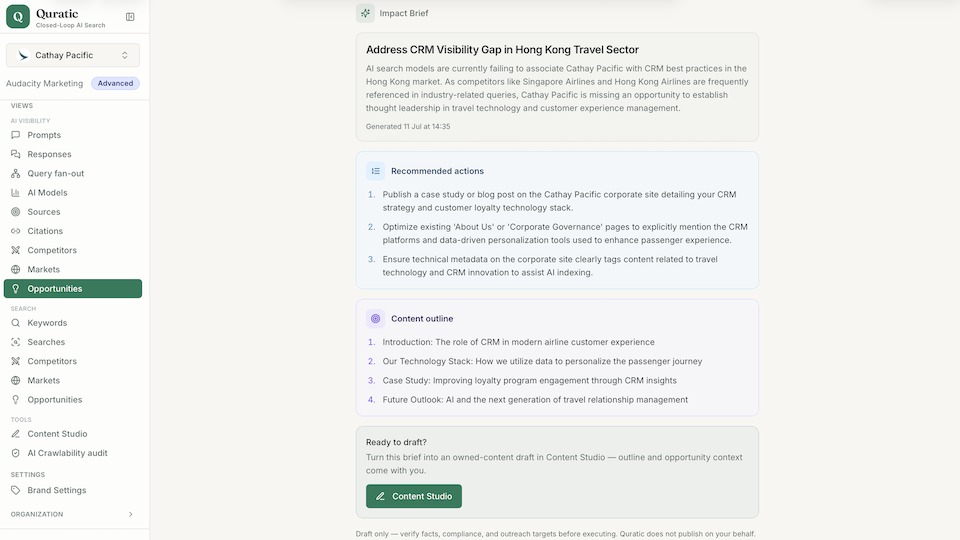
What you get
-
Translate a gap into a plan
Recommended actions, success signals, and an outline — generated from the same prompts, fan-out, and citations that ranked the opportunity.
-
Reviewed, not autonomous
Every brief is a draft your team checks for facts, compliance, and outreach targets before executing — Quratic never acts on a brief for you.
-
One click into Content Studio
Start a Content Studio draft straight from a brief’s outline, so the evidence and structure carry through to the page you review and publish.
How it works
- 1
Pick a ranked opportunity
Start from a high-impact item in Opportunities — a prompt gap, fan-out gap, citation gap, or recommendation.
- 2
Generate the brief
Quratic drafts recommended actions, success signals, things to avoid, and a content outline from the tracked evidence behind that item.
- 3
Review, then act
Your team verifies facts and compliance, then hands the brief to a writer or starts a Content Studio draft from its outline.
Why it matters in Asia-Pacific
Because the underlying gaps come from market-specific collection, a brief for Singapore cites different prompts and sources than one for Japan or Indonesia — so the recommended angle and outline already reflect what local buyers and local AI answers actually surface, not a one-size-fits-all template.
Related capabilities
Frequently asked questions
- What is an Impact Brief?
- A short, data-grounded action plan generated from a ranked opportunity: recommended actions, success signals, things to avoid, and a content outline — a draft for your team to review, not an instruction to execute automatically.
- Does Quratic act on the brief automatically?
- No. Impact Briefs are drafts. Quratic does not publish content, run outreach, or contact anyone on your behalf — your team reviews facts, compliance, and outreach targets before acting.
- How is this different from Content Studio?
- An Impact Brief is the plan; Content Studio is where the page gets drafted, revised in chat, and published. You can start a Content Studio draft directly from a brief’s outline.
- What do briefs cost?
- Generating an Impact Brief uses AI Content Credits, the same metering that covers Content Studio drafts, revisions, and suggestions. See the AI Content Credits glossary entry for plan allowances.
Ready to close the loop on AI search?
Other tools tell you you’re losing AI search. Quratic helps you win it — track, diagnose, brief, and draft content your team reviews and approves before it publishes.
30-day free trial · No credit card · You approve every draft