Why we built Quratic Content Studio — and how it keeps content SEO, AEO, and GEO ready
· 9 min read

Former Product Lead, JPMorgan Asset Management, AIA & AXA
Why Quratic added Content Studio, how it closes the loop from tracked gaps to published pages, and how it keeps content SEO, AEO, and GEO ready without an autonomous agent publishing unattended.
On this page
Tracking told teams exactly where they were invisible in ChatGPT, Perplexity, and Google AI Mode. It never told them what to publish next — or gave them a fast, controlled way to do it. That gap is why we built Quratic Content Studio: a drafting workspace, inside the same product as your visibility data, with a human review step before anything ships.
This post covers why we added it, how it works end to end, and — since this is the part that actually matters for ranking and getting cited — how it keeps every page it produces structured for search engines, answer engines, and generative engines at once.
The gap we kept hearing about
Quratic customers were already doing the hard measurement work: running prompts across models and markets, watching AI Visibility Scores move, and reviewing ranked Opportunities — the prompt gaps, query fan-out gaps, and citation gaps behind a weak score.
Then the workflow broke. Someone exported the gap list to a spreadsheet, handed it to a writer or agency, and hoped the brief survived translation. The writer never saw the actual prompts, the fan-out sub-queries, or which competitor domains AI was citing instead. Drafts arrived weeks later, answered the wrong sub-intent, and — because nobody tested the page against the tracked prompts before publishing — the visibility score stayed flat even after the content went live.
Meanwhile, a different kind of tool appeared: autonomous content agents that promise to skip all of that by publishing unattended. That trades away the one thing B2B marketing and compliance-conscious teams can’t trade away — a human who checks facts, tone, and claims before a page goes live under the brand’s name.
Content Studio is our answer to both problems: keep the evidence attached to the draft, and keep a person in control of publish.
How it closes the loop
Content Studio sits between two things Quratic already did well — measuring visibility and ranking opportunities — and the step that used to happen outside the product entirely.
| Stage | What happens |
|---|---|
| Track | Quratic runs your prompts on a schedule from local browser sessions in each market and records mentions, position, and citations. |
| Diagnose | Prompt gaps, fan-out gaps, and citation gaps roll up into ranked Opportunities. |
| Brief | An Impact Brief turns a ranked opportunity into recommended actions, success signals, and a content outline — generated from the same evidence, not a template. |
| Create | Content Studio drafts the page from that outline, or from an industry template or your own prompt, then you refine it. |
| Review & publish | Your team approves before anything ships to a {project}.quratic.org preview site. Quratic does not publish or reach out on your behalf. |
| Re-track | The next scheduled run measures whether the page moved mention rate, position, or citations on the prompts it was built to answer. |
That last row is the point most content tools miss entirely. A page written to “rank” is a guess until you re-run the exact prompts it targeted and watch what changed. Content Studio drafts stay tied to the opportunity that produced them, so the loop closes automatically on your next tracking cycle instead of requiring a separate audit.
What actually happens inside a session
- Start from a gap or prompt. Pick a recommended action from Opportunities, start from an Impact Brief’s outline, choose an industry template, or write a custom prompt.
- Generate a grounded draft. The first pass is written from your tracked prompt evidence and fan-out sub-queries — not a blank document disconnected from what buyers actually ask AI assistants.
- Revise in chat. Ask for a different angle, tighten a section, or add a market-specific example without starting over.
- Check readiness. Refresh insights for a readiness score and run prompt simulation to see how a model might answer using the draft before you publish it.
- Compare variations. Generate A/B structural variations — different headings, different answer-first framing — and keep version history as you iterate.
- Review, then ship. Submit for your team’s review workflow. Only after approval does it publish to your branded preview site.
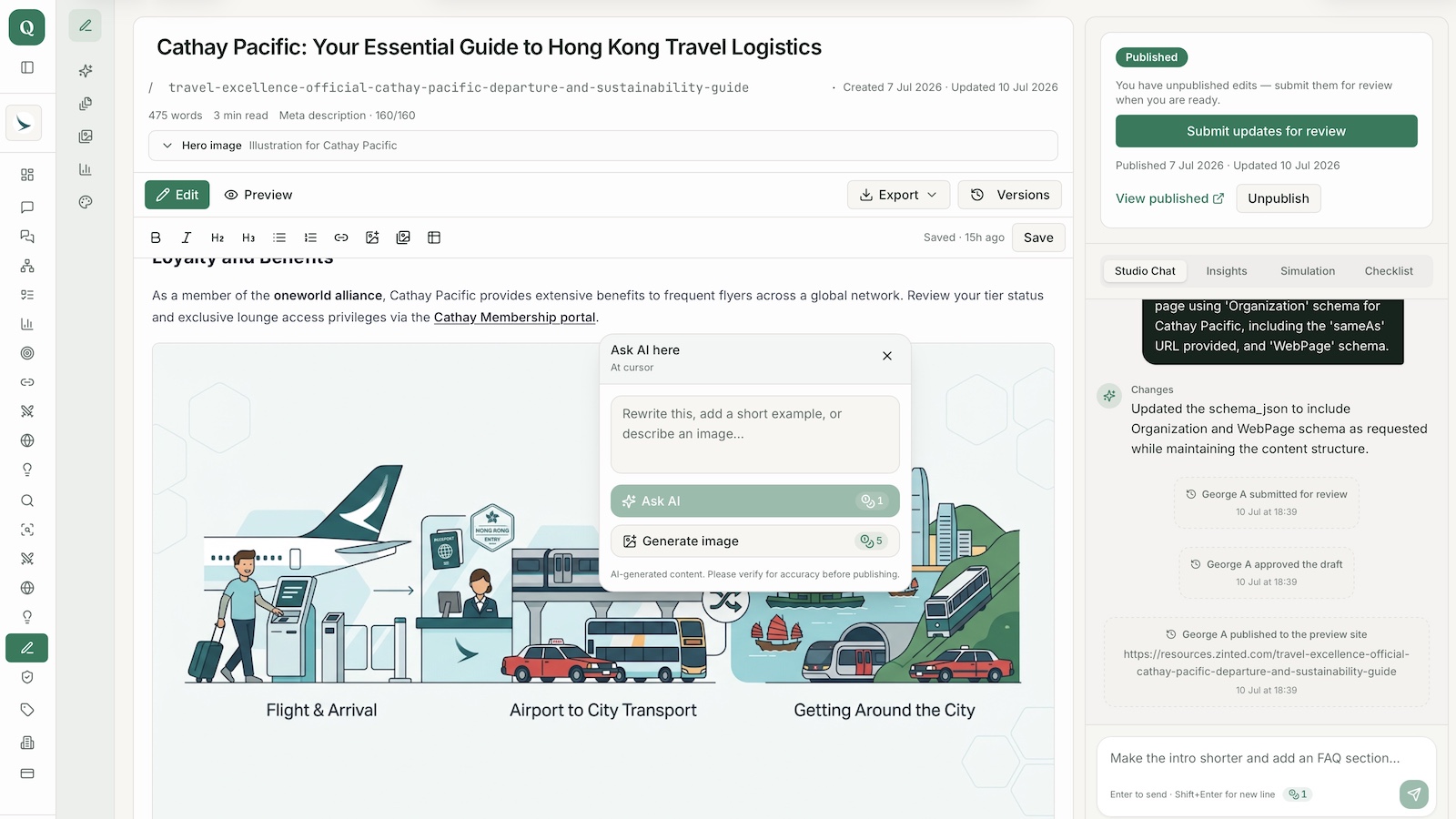
Hero and inline images generate inside the same session. Every text action and the image generator run on AI Content Credits — a flat per-action model (1 credit for drafts, revisions, insights, and simulations; 5 for a generated image) so teams can estimate usage without a token calculator. Publishing itself never costs a credit.
How Content Studio keeps pages SEO, AEO, and GEO ready
This is the part worth being specific about, because “AI-assisted writing” and “content structured for AI retrieval” are not the same claim.
It starts from real prompt evidence, not keyword guesses
Traditional SEO briefs start from search volume. Content Studio drafts start from the actual prompts, query fan-out sub-queries, and citations behind a tracked gap — the sub-intents an AI model already breaks your buyers’ question into. That is closer to how Generative Engine Optimization (GEO) and Answer Engine Optimization (AEO) actually work: you are writing to the questions models ask themselves on the way to an answer, not to a head-term keyword.
Readiness insights and prompt simulation before you publish
Most teams find out whether a page “worked” for AI months later, if they check at all. Prompt simulation lets you test how a model might answer using the draft before it ships, and readiness insights flag structural gaps — missing answer blocks, thin sections, unclear entity references — while you can still fix them for free, before a credit-metered revision or a publish decision.
Answer-first structure, not buried definitions
Pages drafted in Content Studio are built around the same principle behind every answer block on our own site: a question-style heading followed immediately by a self-contained, quotable answer, with supporting detail after — not before. That is the structure Google’s AI features and answer engines like Perplexity extract from, and it is the difference between a page a model can quote verbatim and one it has to interpret first.
Market- and language-scoped by design
A page for Singapore is not a translated page for Japan. Content Studio sessions are scoped to your project’s market and language setup, and the recommendations behind each draft come from local IP collection in that market — so the sub-intents and framing a draft targets reflect what AI actually surfaces for buyers in that country, not a US-datacenter default.
Human review — the signal autonomous agents skip
Factual accuracy is itself a ranking and citation signal. Answer engines increasingly weight source credibility, and nothing damages credibility faster than a hallucinated statistic or an outdated claim shipped unattended. Every Content Studio draft waits for a human review step before it reaches your preview site. That is slower than “publish now,” on purpose — it is the difference between content built to be cited and content that quietly erodes the trust an AI model has in your domain.
Closing the loop is the actual GEO/AEO test
A page is not “done” because it shipped. It is done when the next tracking run shows movement on the prompts it targeted. Because Content Studio drafts stay linked to the opportunity that produced them, you do not need a separate audit to know whether a page worked — your existing tracking cadence answers that automatically.
What this changes for clients
- Agencies and in-house teams get a shared workspace instead of a spreadsheet handoff — the brief, the evidence, and the draft live in one place.
- Compliance-conscious industries (finance, insurance, healthcare) get a mandatory review gate instead of an autonomous agent making claims on their behalf.
- Multi-market teams get drafts pre-scoped to the right country and language instead of one global template stretched across six markets.
- Everyone gets a way to measure whether new content actually moved the visibility metrics it was built to fix — because the loop closes on the next tracked run, not a one-off audit.
FAQ
What is Quratic Content Studio?
Quratic Content Studio is the owned-content workspace inside Quratic: draft generation grounded in your tracked visibility data, chat-based revisions, readiness insights, prompt simulation, A/B variations, and a review step before publishing to a branded preview site.
How is Content Studio different from an autonomous AI content agent?
Autonomous agents draft and publish without a human checkpoint. Content Studio always stops for review — your team approves a draft before it ships. Quratic does not publish content or run outreach on your behalf.
Does Content Studio replace the need for SEO or GEO strategy?
No. Content Studio is the production layer. AI visibility tracking and Opportunities still decide what to write about; Impact Briefs turn that into a plan. Content Studio drafts, refines, and publishes the page.
What does using Content Studio cost?
Content Studio runs on AI Content Credits, included in every paid plan. Most text actions — drafts, revisions, insights, simulations — cost one credit; generated images cost five. Publishing does not consume credits.
Can I publish directly from Content Studio without review?
No — by design. Every draft goes through your team’s review workflow before it reaches your {project}.quratic.org preview site. That review step is the point: it is what keeps AI-assisted content accurate enough to be cited, not just published.
Does Content Studio work across different markets and languages?
Yes. Sessions are scoped to your project’s market and language setup, and drafts are informed by prompt and citation data collected locally in that market — so a Singapore draft and a Japan draft start from different evidence, not a shared translation.
See Content Studio on a tracked opportunity or start a free Quratic trial to turn your next visibility gap into a reviewed, published page.