AI Visibility Score
Updated July 3, 2026 · Reviewed by the Quratic editorial team
Definition
An AI Visibility Score is a single 0–100 measure of how present a brand is in AI-generated answers, combining how often it is mentioned across a tracked set of prompts (mention rate), how prominently it appears within each answer (position), and how many AI engines and markets surface it. It is the AI-search equivalent of a rank-tracking score.
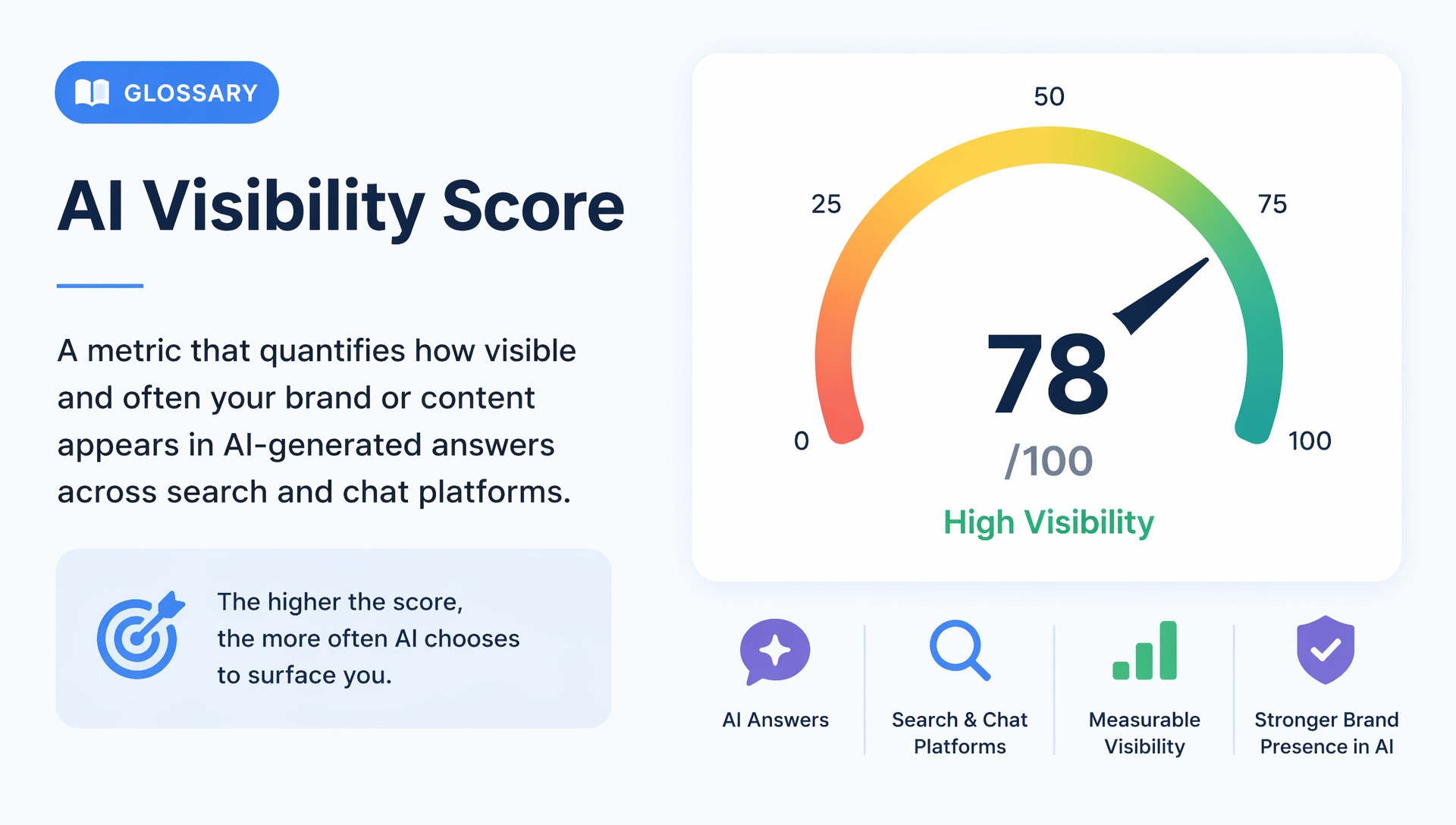
How an AI Visibility Score is built
Visibility in AI answers is not a single yes/no event, so a useful score blends three observable inputs measured over a defined prompt set:
- Mention rate — the share of tracked prompts where the brand is named at all. This is the dominant input; a brand that is never mentioned scores near zero regardless of anything else.
- Position — how early and prominently the brand appears within the answer. Being the first named option carries more weight than a passing mention in a closing sentence.
- Coverage — how many answer engines and markets surface the brand. Appearing in one engine in one country is weaker than appearing across ChatGPT, Perplexity, and Google AI Mode in several markets.
Scoring these on a 0–100 scale makes movement legible to people who already think in rank-tracking terms, without implying the false precision of a single mention count.
Quratic’s formula
In the Quratic dashboard, PDF reports, and alert thresholds, the AI Visibility Score is a weighted composite of the three inputs above, computed over your active prompts, models, and markets in the selected period:
| Input | Weight | How it is measured |
|---|---|---|
| Mention rate | 55% | Share of collected AI responses that name your brand |
| Position | 25% | Prominence when mentioned — average list position mapped to 0–100 (position #1 → 100; each step down costs 12 points) |
| Coverage | 20% | Share of distinct model × market cells with at least one mention |
The final score is rounded to the nearest whole number on a 0–100 scale. If your brand is never mentioned in the period, the score is 0 — mention rate is the gate; position and coverage cannot compensate for zero presence.
Mention rate is still shown separately in charts and tables. Use the composite score for executive summaries and week-over-week movement; use mention rate when you need the raw frequency metric.
Full methodology: Glossary methodology.
How it differs from share of voice and citation rate
An AI Visibility Score is absolute — it asks “how present is this brand?” Share of voice is relative — it asks “what proportion of the category’s mentions does this brand own versus competitors?” Citation rate is narrower still — it asks “how often does the engine link a source the brand controls?” A brand can hold a high visibility score yet a low citation rate if models describe it from third-party sources without linking its own domain.
In Asian markets
Because mention rate and coverage are inputs, a brand’s AI Visibility Score is meaningless without a stated market and prompt language. A score computed only from English prompts overstates presence for a brand whose buyers research in Japanese or Korean. Quratic computes the score per market and per language so the number reflects what local buyers actually see, rather than a US-default view.
Example
A brand named in 40% of tracked prompts, usually around position #2, across two of three engines in Singapore might land in the low 50s. After shipping localized answer-first content and earning two third-party citations, mention rate and coverage rise and the score moves into the 70s — the kind of movement a GEO program is built to produce.