Hreflang
Updated June 22, 2026 · Reviewed by the Quratic editorial team
Definition
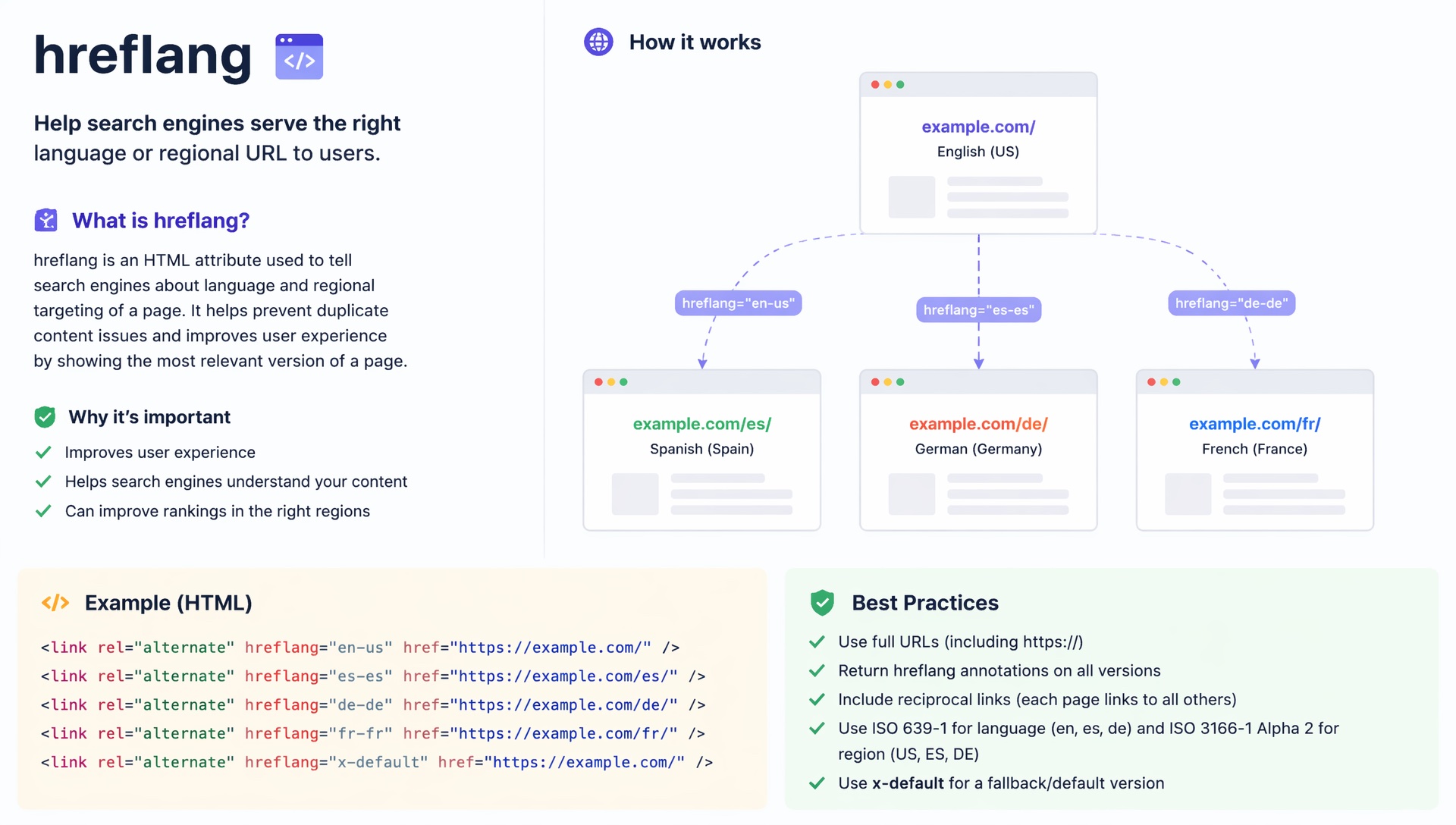
Hreflang is an HTML attribute (rel="alternate" hreflang="x") that tells search engines which language or regional URL is the correct version of a page for a given locale. It reduces duplicate-content confusion and helps the right market see the right URL in results — a prerequisite for multilingual GEO.
What hreflang solves
When the same content exists at /, /jp/, and /sg/, search engines need a signal: which URL belongs to which audience. Hreflang declares reciprocally linked alternates — each locale page lists the others — so Google can serve quratic.com/jp/ to Japanese queries and the Singapore variant to SG queries instead of collapsing everything to one global URL.
Implementation options: <link rel="alternate" hreflang="ja-JP" href="..."> in HTML, HTTP headers, or XML sitemap entries. x-default marks the fallback for unmatched regions.
How hreflang differs from canonical and from GEO
A canonical URL picks one preferred URL among duplicates. Hreflang says these are all valid — for different audiences. Neither guarantees AI citation: multilingual GEO still needs in-language answer blocks and local sources. Hreflang helps discovery and the correct organic URL; it does not make English authority transfer to Japanese answers.
In Asian markets
Hreflang is load-bearing for brands running nine markets from one domain. Common failures: one-way tags (not reciprocal), language-only codes without region (en vs en-SG), and hreflang pointing to machine-translated stubs. For CJK entity disambiguation, hreflang pairs should align with localized entity names on each alternate, not identical English titles on every variant.
Example
A SaaS brand adds reciprocal hreflang for en-SG, ja-JP, ko-KR, and x-default. Organic traffic splits correctly by country; after native FAQ content ships on each alternate, localized AI answers begin citing the matching locale URL instead of the US homepage.