Generative Engine Optimization (GEO): the complete guide for Asian brands
PublishedMay 22, 2026 · UpdatedJune 19, 2026 · Quratic Team · 5 min read
GEO is how brands get mentioned in AI answers. This guide covers strategy, metrics, and execution for marketing teams in Southeast and East Asia.
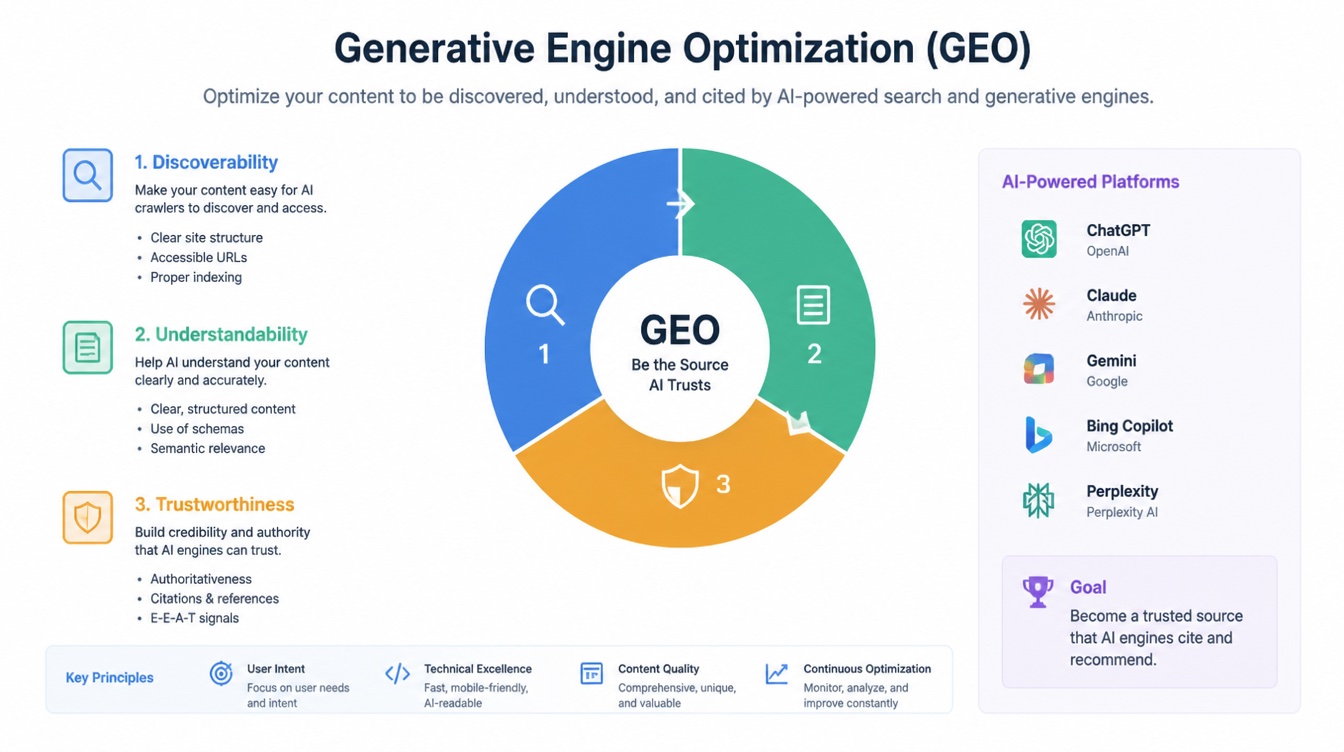
Generative Engine Optimization (GEO) is the practice of improving how often and how favourably AI platforms mention your brand in generated answers. For Asian brands, GEO matters because AI responses vary by country — and buyers in Singapore, Japan, and Korea increasingly start their research in ChatGPT and Perplexity, not Google alone.
This guide covers what GEO is, how it differs from SEO, which metrics to track, and how to build a GEO programme for Asian markets.
What is Generative Engine Optimization?
GEO is the discipline of measuring and improving your brand’s presence in AI-generated answers — across ChatGPT, Perplexity, Google AI Mode, Gemini, and other surfaces.
Unlike SEO, which optimizes for ranked blue links, GEO optimizes for being named, positioned, and described accurately inside the answer itself. A user may never click a link; they read the AI summary and form a shortlist from it.
How is GEO different from SEO?
| Dimension | SEO | GEO |
|---|---|---|
| Primary outcome | Rank in search results | Mentioned in AI answers |
| User behaviour | Click through to your site | Read AI summary; may not click |
| Measurement | Rankings, CTR, impressions | Visibility, position, sentiment |
| Content lever | Pages, backlinks, technical SEO | Citations, authority, structured facts |
| Local variation | Country domains and SERPs | Country IP and live web retrieval |
SEO still matters — AI platforms cite web sources. But GEO adds a new layer: are you in the answer at all?
Why does GEO matter more in Asia?
Three factors make Asia a distinct GEO challenge:
- Country-specific answers. Perplexity and Google AI Mode pull live web results that differ by IP location. A CRM recommendation in Singapore is not the same as in Tokyo.
- Multilingual prompts. Buyers ask questions in English, Japanese, Korean, Bahasa, and Cantonese. Each phrasing can surface different brands.
- Rising AI adoption. Enterprise and consumer adoption of AI assistants is accelerating across SG, JP, KR, MY, ID, and HK — often ahead of Western averages in daily tool usage.
If you measure GEO from a US datacenter, you are optimizing for a market your buyers may never see.
What metrics should Asian brands track?
The core GEO metrics map to buyer decision-making:
| Metric | What it tells you |
|---|---|
| Visibility | How often AI mentions your brand for target prompts |
| Position | Whether you are named first, second, or third |
| Sentiment | How positively or negatively AI describes you |
| Share of voice | Your mentions vs tracked competitors |
| Citations | Which domains AI cites when recommending you (or competitors) |
Track these by country and by model. A strong ChatGPT score in Japan does not guarantee visibility in Perplexity Singapore.
How do you build a GEO programme?
1. Define prompt categories
Group prompts by intent: category discovery (“best CRM for startups”), comparison (“X vs Y”), and brand-specific (“is [brand] good for enterprise”).
2. Assign countries
Each prompt should map to a target market. A prompt assigned to Japan should be collected from a Japanese residential IP — not a generic global endpoint.
3. Track competitors
Add the brands buyers compare you against. Share of voice only matters relative to the competitive set.
4. Choose models
Different models cite different sources. ChatGPT, Perplexity, and Google AI Mode can disagree on the same prompt. Monitor all surfaces that matter for your category.
5. Act on citations
When AI cites a review site, publication, or community you are absent from, that is a concrete content or PR action — not a vague “improve SEO” task.
6. Refresh on a schedule
AI answers drift. Weekly or daily refresh catches changes after product launches, funding news, or competitor campaigns.
What collection method should you use?
Use browser-based collection on local residential IPs — not vendor APIs from a datacenter. API responses are sanitized and location-agnostic. Browser collection mirrors what a buyer in the target country actually sees.
Quratic collects this way across six Asian markets: Singapore, Japan, South Korea, Malaysia, Indonesia, and Hong Kong.
FAQ
Is GEO replacing SEO?
No. GEO complements SEO. Many AI answers cite web pages, so strong content and backlinks still help. GEO adds measurement and optimization for the AI answer layer itself.
How long before GEO results show movement?
Depends on citation sources and competitive dynamics. Most teams see measurable baseline data within the first collection cycle, with trend shifts over 4–8 weeks of scheduled monitoring.
Do I need different prompts per country?
Yes, if buyer language and competitive landscapes differ. Track “best project management tool” in English for Singapore and in Japanese for Tokyo as separate prompts, each assigned to the right country.
Can small teams run GEO?
Yes. Start with 10–20 high-intent prompts per market, two competitors, and two models. Expand as you learn which prompts drive the most variation.
Ready to baseline your GEO metrics? Start a free trial or compare AI visibility tools for Asia.