Multilingual GEO
Updated June 20, 2026 · Reviewed by the Quratic editorial team
Definition
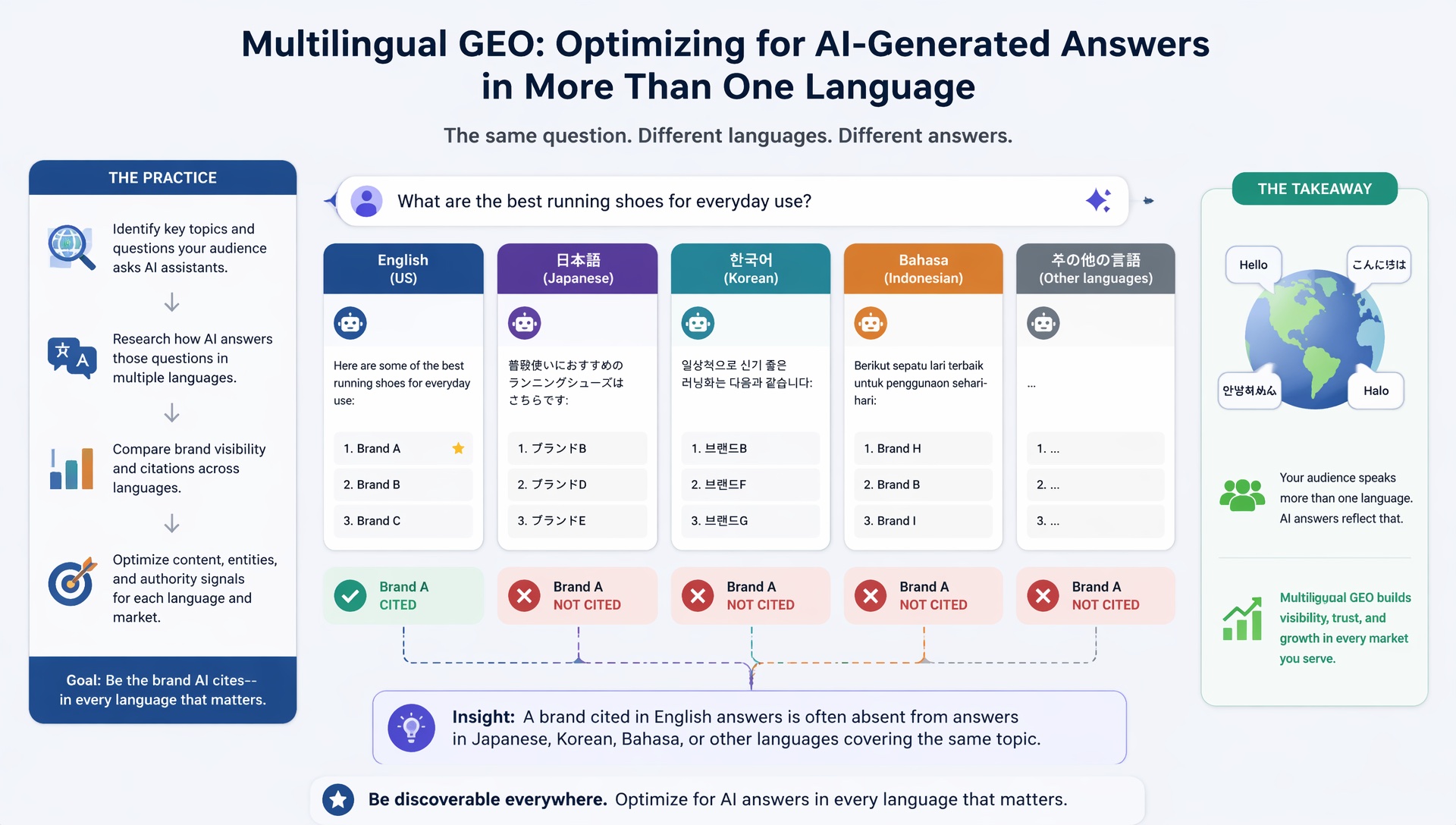
Multilingual GEO is the practice of optimizing for AI-generated answers in more than one language, recognizing that a brand cited in English answers is often absent from answers in Japanese, Korean, Bahasa, or other languages covering the same topic. It treats each language–market pair as a separate visibility surface with its own content, entities, and citation sources.
Why one language is not enough
Generative engines answer in the language of the prompt, and they assemble each answer from sources in or near that language. A brand with strong English content can be the default citation for “best [category] tool” in English while being entirely absent from the same query asked in Japanese — because the model has no Japanese-language source that names it. Multilingual GEO closes that gap deliberately, language by language, rather than assuming English authority transfers.
What it requires beyond translation
Translation alone rarely moves the needle. Multilingual GEO needs:
- Native answer-first content per language, not machine-translated pages, so passages read as authoritative source material.
- Consistent entities across scripts — the same brand resolvable whether written in Latin characters, kana/kanji, or Hangul. This is where CJK entity disambiguation becomes load-bearing.
- Local citation sources — reviews, directories, and press in-language, since models ground in-language answers on in-language sources.
How it differs from international SEO
International SEO is largely a technical discipline: hreflang, localized URLs, and serving the right page to the right region. Multilingual GEO inherits those foundations but adds a citation problem — even a perfectly localized page is useless if no in-language source the model trusts names your brand. The win condition shifts from “the right page is indexed” to “the brand is named in the in-language answer.”
In Asian markets
This is where multilingual GEO is least optional. Quratic’s six core markets span at least five content languages and three writing systems, and model market share differs across them. A brand can rank #1 on local Google yet be invisible in local-language AI answers — a gap that only shows up when visibility is measured per language and per market rather than globally. Quratic tags every prompt with a language, filters dashboards by language, and surfaces side-by-side visibility (e.g. English vs Japanese in Japan).
Example
A travel brand visible in English Perplexity answers ships native Japanese and Korean guides, registers consistent entities across scripts, and earns in-language review mentions. Over the next cycles it begins appearing in Japanese AI Mode and Korean ChatGPT answers it had never surfaced in before.