AI hallucination
Updated June 20, 2026 · Reviewed by the Quratic editorial team
Definition
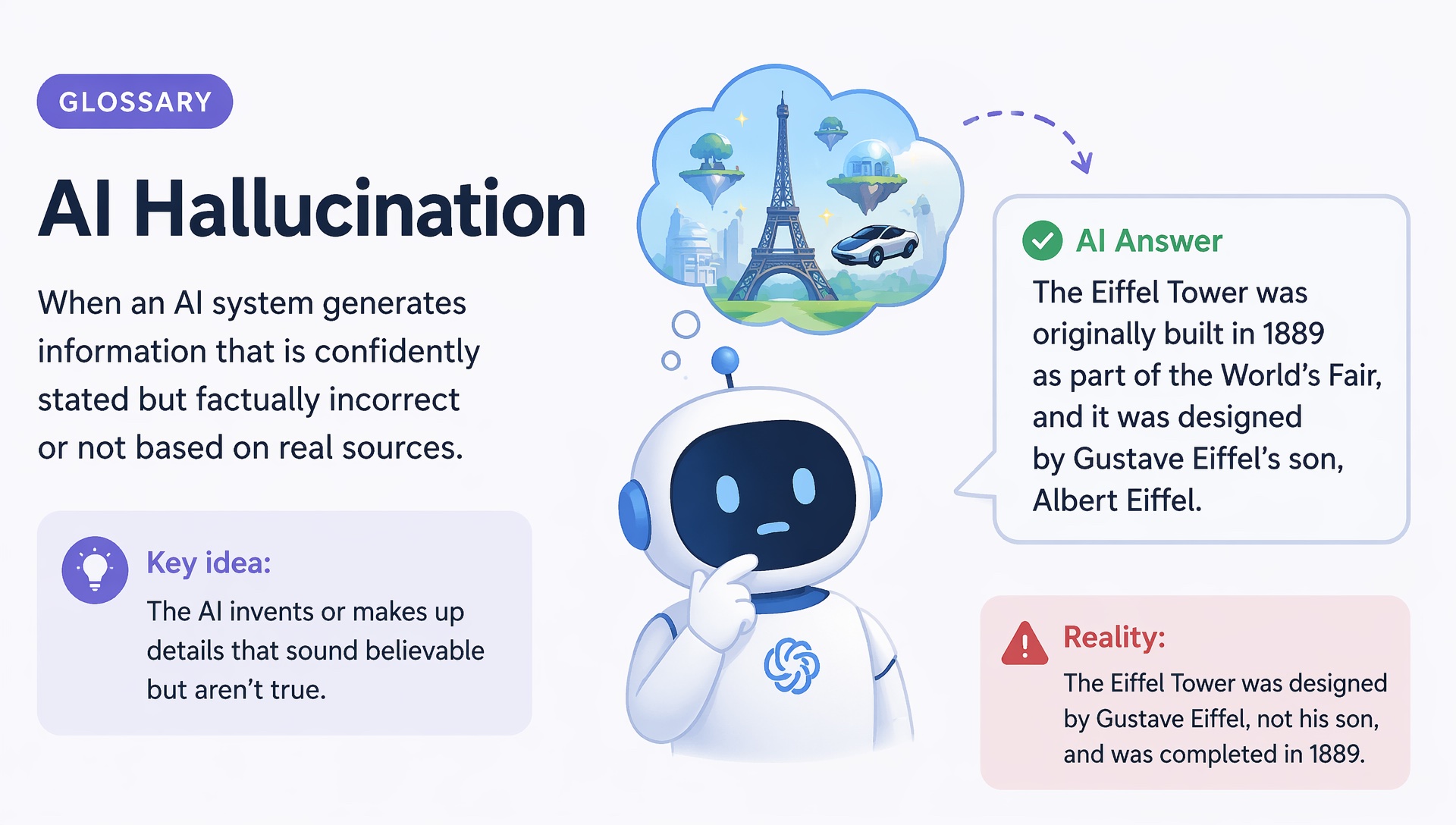
An AI hallucination is when a language model states a false or unverifiable claim with high confidence — inventing pricing, features, founders, or citations that do not exist. In brand analytics, hallucinations are reputation risk: buyers act on wrong facts the model attributed to you.
Wrong facts wear your logo
Hallucinations are not abstract NLP failures — they are misinformation with your brand attached. A model may cite a competitor’s pricing as yours, invent a security certification, or merge two companies with similar names. Monitoring mention and claim accuracy is part of modern brand ops, not an ML research curiosity.
Mitigation through grounding and entity clarity
Model grounding and RAG reduce but do not eliminate hallucinations. Brand-side levers: authoritative first-party pages with dated facts, structured data, consistent brand entity markup, and third-party corroboration. When the retrieval set contains one clear source of truth, the model has less room to improvise.
In Asian markets
Low-resource languages and romanized brand names increase hallucination rates — fewer grounded sources, more parametric guessing. Multilingual GEO and CJK entity disambiguation directly reduce cross-script merge errors.
Example
ChatGPT states an incorrect enterprise tier price for a SaaS vendor. After the vendor publishes an indexed pricing FAQ with schema and earns two independent reviews repeating the figure, subsequent answers converge on the correct number.