How we collect AI search data
Why browser-based collection on local IPs gives marketers a truer picture of AI visibility — especially in APAC markets.
AI answers are not static. They change by country, language, platform, and even the IP address of the person asking. When a buyer in Japan asks Perplexity for the best CRM, they may get a different answer than someone in the US — with different brands, sources, and sentiment. Quratic is built to measure that reality.
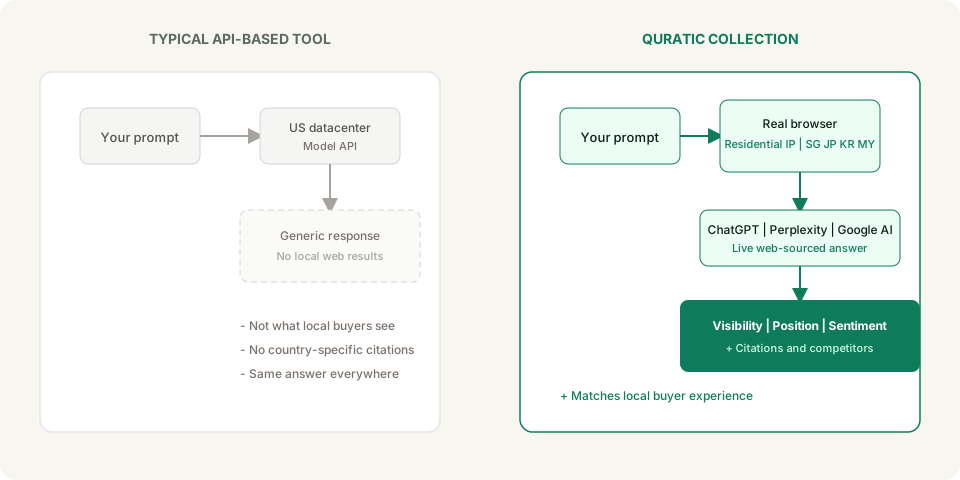
Why we do not rely on vendor APIs
Many AI-visibility tools send your prompt to a model API from a US or EU datacenter. That produces a clean, repeatable response — but it is not what your customer sees.
Typical API-based tool
- Response from a datacenter IP, often in the US or EU
- Generic answer with no live web retrieval or local context
- Can differ significantly from what buyers see in Singapore, Tokyo, or Seoul
Quratic collection
- Real browser session on the actual AI product interface
- Residential IP in the target country (SG, JP, KR, MY, ID, HK)
- Captures live web-sourced answers, citations, and local brand mentions
Our collection process
-
Schedule prompts
You define the questions that matter — in any language — and assign each to a target market and AI model.
-
Collect on a cadence
On your plan schedule (weekly to daily), our workers run each prompt through a browser on a local residential proxy and store the full response.
-
Analyse and surface insights
We score visibility, position, and sentiment, compare against competitors, and map the domains AI cites — all in your dashboard.
How we reach each AI platform
Different AI surfaces require different collection approaches. We use the method that best mirrors a real user for each platform.
Web AI surfaces
ChatGPT, Perplexity, Google AI Mode, and Google AI Overviews are collected through automated browser sessions on market-targeted residential IPs — the same path a local user takes.
ChatGPT · Perplexity · Google AI Mode · Google AI Overviews
Authenticated AI surfaces
Gemini, Microsoft Copilot, and Claude require logged-in browser sessions. Operators use the capture console on local IPs to collect responses that match signed-in user experiences.
Gemini · Microsoft Copilot · Claude
What this means for marketers
Trust your numbers
When you report AI visibility to leadership or clients, the data reflects what buyers in that market actually see — not a sanitized API snapshot.
Win in local markets
See how your brand ranks in Japan vs Singapore vs Korea. Local IP collection reveals market-specific gaps that global tools miss.
Act on real citations
Because we collect live web-sourced answers, the domains AI cites are the ones influencing real purchase decisions in that country.
Fair competitor comparisons
Share-of-voice metrics compare brands under the same collection conditions — same market, same model, same schedule.
Use our vendor collection checklist before your next demo — the questions that reveal whether a tool measures what local buyers actually see. View the checklist →
Questions to ask vendors about collection
Use this checklist in demos and procurement calls. Collection geography and IP type determine whether your visibility data matches what local buyers see.
Most AI visibility platforms now claim “browser-based” or “real user” collection. The details that matter — API vs UI, datacenter vs residential IP, and per-market model support — are often buried in sales decks. Ask these questions before you sign.
Collection architecture
- Do you call vendor LLM APIs, or collect from the consumer-facing UI?
- Why it matters: API responses are often sanitized and location-agnostic. UI collection matches what buyers see in ChatGPT, Perplexity, and Google AI Mode.
- Which exact interfaces do you use — public web, logged-in session, or mobile?
- Why it matters: Gemini, Copilot, and Claude behave differently when authenticated. Your measurement should match the user experience you care about.
- What IP type runs each prompt — residential, datacenter, or a mixed proxy pool?
- Why it matters: Geo-labeled datacenter IPs can return different brands and sources than a home broadband connection in the target country.
- Can you prove collection from a residential IP in our target market — not just “country targeting”?
- Why it matters: Many tools geo-tag datacenter traffic. For APAC reporting, residential proof is the difference between approximate and trustworthy SOV.
Geographic fidelity
- Is country or region set per prompt, or only at account level?
- Why it matters: Multi-market teams need prompt-level assignment so Singapore and Japan data never get blended.
- Which AI models work in our priority markets — and are any US-only?
- Why it matters: Some platforms limit Gemini or Copilot to US collection even when you select another country.
- Where is coverage strongest vs weakest? Which APAC markets are first-class?
- Why it matters: Global tools often optimize for US/UK/EU. Ask for honest limits before you report to local leadership.
- Are there unsupported country codes per model? Can we see the list?
- Why it matters: A dashboard may show “Japan” while specific engines silently fall back to US collection.
Data fidelity
- Do you capture the full citation list and source URLs from live web answers?
- Why it matters: Perplexity and Google AI Mode answers depend on live retrieval. Partial capture hides the sources shaping recommendations.
- Can we export raw responses to verify against a manual in-country check?
- Why it matters: Side-by-side verification is the fastest way to catch collection geography gaps.
- How often do prompts run, and do you average multiple responses per day?
- Why it matters: AI answers vary run-to-run. Understand whether your score is one snapshot or a daily average.
- How is visibility or share of voice calculated — mentions, citations, or weighted prominence?
- Why it matters: Scores are not comparable across vendors. Know the formula before mixing tools in one report.
Trial verification
- Will you run five of our prompts side-by-side against a manual browser check from our market?
- Why it matters: Vendors confident in local collection should welcome this. Hesitation is a signal.
- If our manual check differs from your dashboard, how do you explain and resolve it?
- Why it matters: Good vendors document IP routing, session type, and model version. Vague answers suggest opaque collection.
- Can we use your tool alongside a regional platform without mixing metrics in one chart?
- Why it matters: Enterprise teams often run a global tool for HQ and a regional tool for Asia-Pacific — if collection methods differ, charts must stay separate.
Quick verification test
Before committing budget, run this five-step check in your primary market:
-
Pick five prompts
Choose category questions your buyers actually ask — in the local language if relevant.
-
Run them manually
Open the AI product from a browser in the target country (or a consumer connection in that market). Note brands, order, and cited sources.
-
Run the same prompts in the vendor trial
Assign each prompt to the same country and models. Wait for the first collection cycle.
-
Compare brands and citations
Material differences in brands named or sources cited usually mean collection geography does not match local reality.
-
Document IP and interface answers
Save the vendor’s written answers on API vs UI, IP type, and per-model country support for procurement records.
Ready to close the loop on AI search?
Other tools tell you you’re losing AI search. Quratic helps you win it — track, diagnose, brief, and draft content your team reviews and approves before it publishes.
30-day free trial · No credit card · You approve every draft