Share of voice in AI answers: the metric replacing keyword rankings
PublishedJune 3, 2026 · Quratic Team · 4 min read
Keyword rankings do not show whether AI recommends your brand. Share of voice in AI answers does. Here is how to measure and improve it.
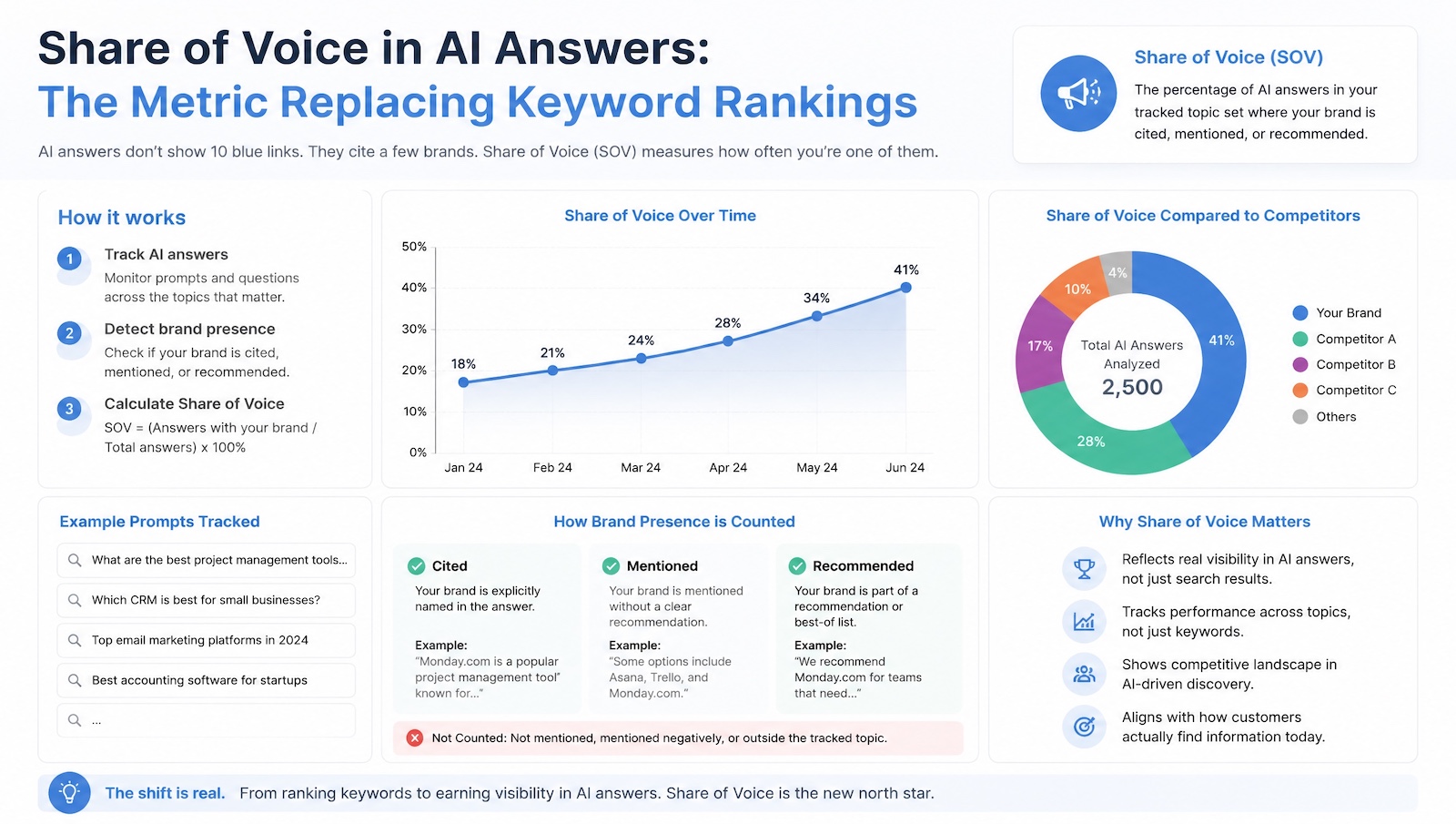
Share of voice in AI answers measures how often your brand is mentioned relative to competitors for the prompts that matter in your category. As buyers shift from clicking blue links to reading AI summaries, this metric is replacing keyword rankings as the competitive benchmark for marketing teams.
What is share of voice in AI answers?
Share of voice (SOV) in AI visibility is:
Your brand mentions ÷ total brand mentions (yours + tracked competitors) × 100
Measured across scheduled prompt runs, by model, country, and time period.
If AI names three brands and yours appears in 90 of 100 responses while a competitor appears in 60, your SOV depends on how all tracked brands split those mentions.
How is this different from SEO share of voice?
| SEO SOV | AI SOV |
|---|---|
| Based on organic search impressions or clicks | Based on in-answer brand mentions |
| Tracks visibility in SERP listings | Tracks visibility inside generated text |
| One ranking position per keyword | Multiple brands named per answer |
| Less sensitive to IP location | Highly sensitive to country and model |
You can rank #1 on Google and still be absent from the ChatGPT answer for the same intent.
Why does AI SOV matter for Asian markets?
Category winners are decided inside the answer before a buyer visits any website. In markets where:
- Buyers ask AI in local languages
- Domestic competitors are strong
- Citations come from local publishers
…a global SOV number from US collection will not reflect competitive reality. Measure SOV per country with local IP collection.
How to calculate AI share of voice
- Select prompts — category, comparison, and brand-specific
- Add competitors — the brands AI names alongside yours
- Run on a schedule — weekly minimum; daily for fast-moving categories
- Count mentions — binary (mentioned or not) per response
- Segment — by model (ChatGPT vs Perplexity), country, and prompt cluster
Example (simplified):
| Brand | Mentions (of 100 runs) | SOV |
|---|---|---|
| Your brand | 72 | 40% |
| Competitor A | 54 | 30% |
| Competitor B | 38 | 21% |
| Competitor C | 16 | 9% |
What drives SOV changes?
- Citation source shifts — AI starts citing a publication where a competitor is featured
- Product news — launches, funding, outages change recommendation patterns
- Content gaps — missing comparison pages, outdated facts, weak local profiles
- Model updates — ChatGPT and Perplexity refresh retrieval behaviour
- Competitive PR — reviews, awards, and community threads influence answers
How do you improve AI share of voice?
- Find prompts where you are absent — highest priority fixes
- Analyse citations when competitors win — which domains does AI trust?
- Create or update content on cited domains — profiles, guest posts, accurate facts
- Track sentiment — being mentioned negatively is worse than being absent
- Monitor by model — improve Perplexity SOV separately from ChatGPT SOV
FAQ
Is 100% SOV realistic?
No. Most categories have 3–5 brands named per answer. Target leadership on high-intent prompts, not universal dominance.
How many competitors should I track?
Start with 3–5 direct competitors per market. Too many dilutes actionability; too few misrepresents the category.
Does SOV replace NPS or brand tracking?
No. SOV is competitive and channel-specific. Use it alongside brand surveys and organic traffic — not instead of them.
Measure share of voice with Quratic — visibility, position, sentiment, and citations by model and country.